


Beyond buy and hold: systematic portfolio strategies for multi-asset-class investing
For DIY investors, the simplest portfolio choice often seems like the best one. Why not just buy the entire global market with an ETF like ACWI (MSCI All Country World Index) and hold it forever? It is diversified, low-cost, and historically has delivered solid returns. This "plain vanilla" 100% equity approach is a legitimate baseline—and for investors with decades until retirement and strong emotional discipline, it may well be sufficient.
However, simplicity in construction does not always translate to simplicity in execution. The journey of a 100% equity portfolio—with its significant drawdowns and high volatility—tests the resolve of even disciplined investors. During the 2008 financial crisis, global equities fell over 50% from peak to trough. In early 2020, markets dropped 30% in a matter of weeks. For those with shorter investment horizons or approaching retirement, being forced to sell during such downturns can derail critical financial goals. Even for long-term investors, the psychological strain of watching substantial portfolio declines can lead to poorly timed exits from the market.
Systematic, rules-based strategies aim not just for competitive returns, but for a more resilient path that may be easier to maintain through various market conditions. By incorporating different asset classes and disciplined rebalancing, these approaches can potentially reduce drawdowns and volatility whilst still capturing much of the market's long-term growth.
In this article, we examine five systematic portfolio approaches:
- Baseline: 100% ACWI (global equity)
- Fixed allocation strategies:
- Classic 60/30/10 (global equity/fixed income/gold)
- Inverse volatility weighted allocation across the same asset classes
- Adaptive allocation strategies:
- Monthly optimisation across 4 ETFs
- Monthly selection and optimisation from a pool of 10 assets
Crucially, we focus exclusively on systematic approaches—rules-based strategies that remove subjective decision-making. As Barber and Odean's seminal 2000 research demonstrated, frequent discretionary trading typically leads to poor outcomes for individual investors. Each portfolio we examine can be implemented with clear, repeatable rules requiring no market timing or stock-picking skill.
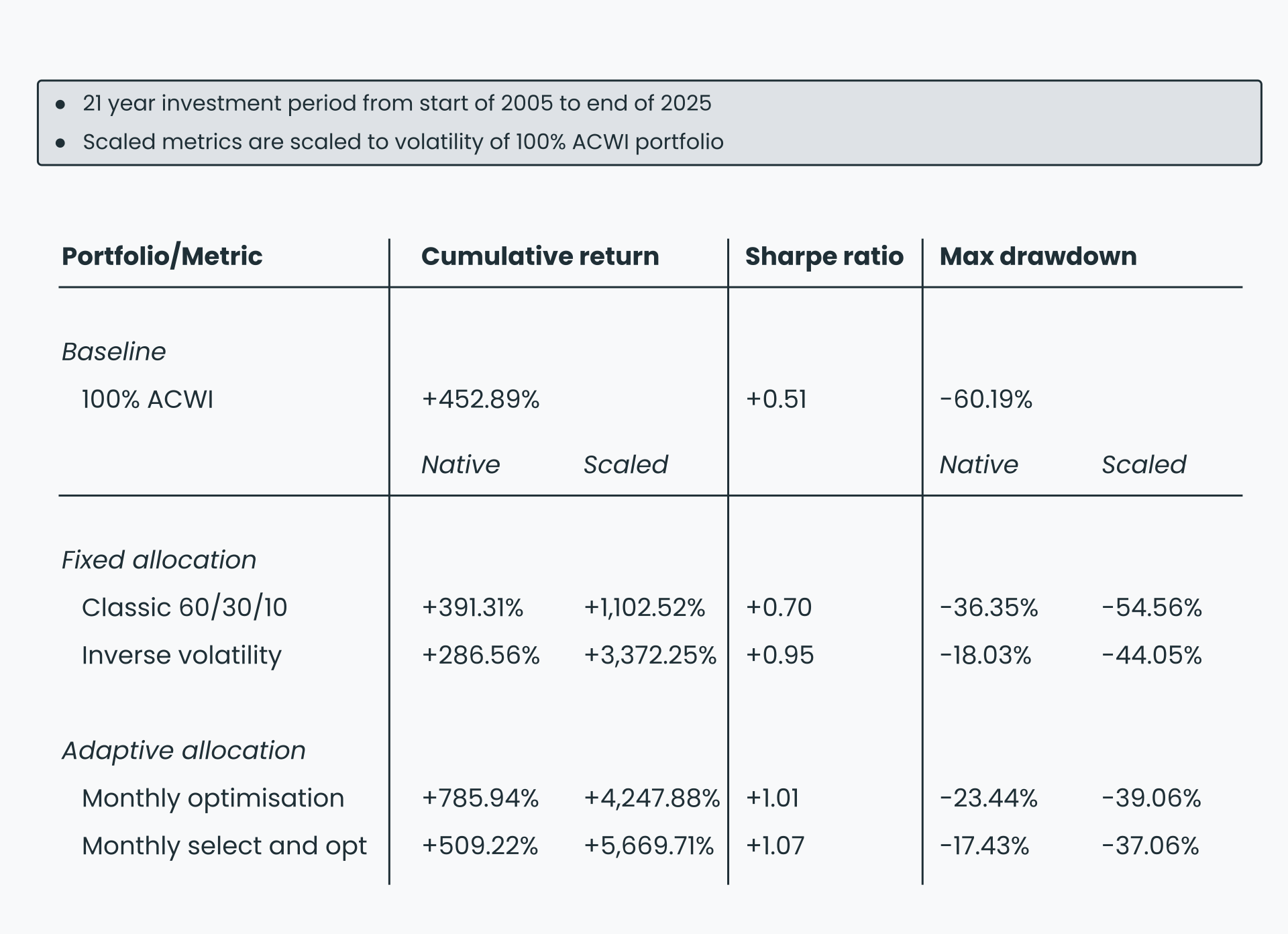
Overview of portfolio performance statistics, 2005 - 2025
To compare strategies fairly, we report both native portfolio statistics (realistic for DIY investors) and volatility-scaled versions. Volatility-scaling uses leverage to match each portfolio to the ACWI's risk level, enabling direct comparison of absolute returns and risk metrics like maximum drawdown at equivalent volatility levels. We also report the Sharpe ratio—a measure of return earned per unit of risk taken. Higher Sharpe ratios indicate more efficient strategies. For practical implementation, focus on native statistics; scaled versions demonstrate what these strategies could deliver at equity-like risk levels.
The data reveals surprising findings. Whilst absolute returns matter, they tell only part of the story. For DIY investors managing their own portfolios, how a strategy performs during difficult markets can be just as important as its long-term return—an insight grounded in decades of behavioural finance research.
Beyond returns—why risk metrics matter for DIY investors
Before examining the portfolios themselves, it is worth understanding why we are comparing more than just final returns. A portfolio is not merely a set of numbers on a spreadsheet—it is an investment experience. For DIY investors, the "investability" of a strategy—how easy it is to stick with through market turmoil—often matters more than theoretical performance.
Two insights from behavioural finance explain why:
- Loss aversion (Kahneman and Tversky, 1979): losses hurt roughly twice as much as equivalent gains feel good. A portfolio that suffers a 50% drawdown does not just deliver poor short-term returns—it creates profound emotional distress that dramatically increases the odds an investor will abandon the strategy at precisely the worst moment. The relationship is clear: higher maximum drawdown translates directly to higher psychological disutility.
- Myopic loss aversion (Benartzi and Thaler, 1995): when investors check their portfolios frequently—and most do, whether weekly or even daily—the pain of repeated losses accumulates. High volatility means more frequent negative experiences, each creating emotional disutility and temptation to switch strategies. Here too, the pattern holds: higher volatility generates higher psychological disutility, as investors endure a steady drumbeat of portfolio declines.

High max drawdown and volatility drive psychological disutility
These are not abstract academic concepts—they describe real behaviour that consistently undermines investment outcomes. The evidence is clear: investors who experience severe drawdowns or persistent volatility are significantly more likely to abandon their strategies during market stress, crystallising losses and forfeiting subsequent recoveries.
The best systematic portfolio for a DIY investor is therefore one that achieves strong returns whilst actively managing the psychological journey—limiting drawdowns, reducing volatility, and minimising the emotional triggers that lead to poor decision-making. Discipline is not unlimited; strategies that preserve it have a measurable advantage in real-world outcomes.
The 100% ACWI portfolio—simple to build, hard to hold
The appeal of a 100% ACWI portfolio is undeniable: maximum simplicity. Buy one globally diversified equity ETF, reinvest dividends, and let compounding do its work. There are no rebalancing decisions, no asset allocation spreadsheets, and minimal ongoing effort. For investors with decades until they need the capital and the temperament to withstand volatility, this approach has delivered respectable long-term returns.
Yet the challenge lies not in the strategy's long-term merit, but in its short-term journey. The all-equity portfolio subjects investors to severe drawdowns during market crises—periods when portfolio values can decline dramatically and remain depressed for extended periods. For those with shorter time horizons—planning to use the capital within 5-10 years for a house purchase, business investment, or approaching retirement—the timing risk is substantial. Investing a lump sum just before a major correction can mean watching half the capital evaporate, with no guarantee of recovery within the needed timeframe.
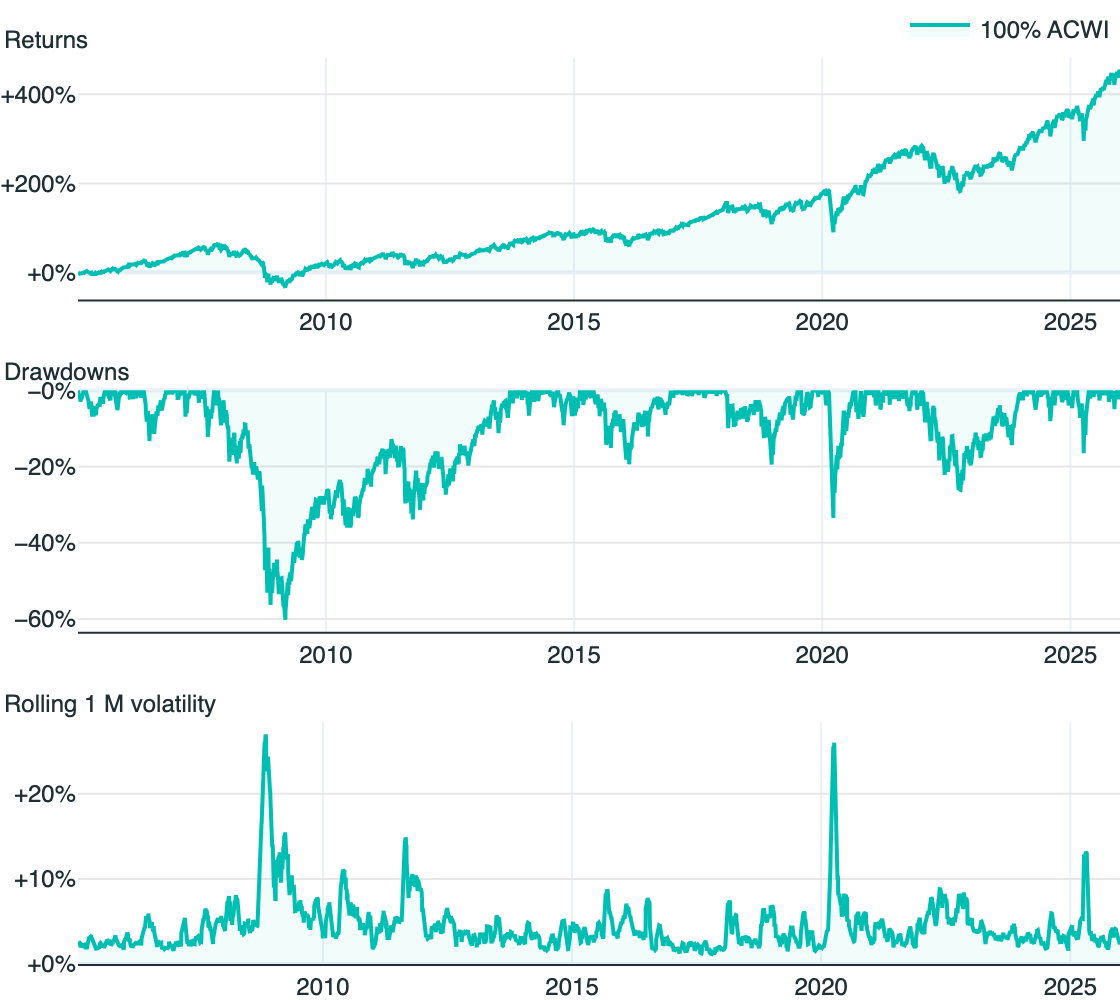
100% ACWI portfolio performance statistics, 2005 - 2025
The volatility picture reinforces this concern. During the 2008 financial crisis, one-month rolling volatility peaked at 27% in November 2008. It reached 26% again in April 2020 during the COVID-19 market panic. For an investor with a USD 100,000 portfolio, this translates to potential monthly swings of ±USD 27,000. More than a quarter of total wealth appearing or disappearing within 30 days creates profound psychological discomfort that most investors struggle to endure.
Faced with this reality, many self-directed investors who choose the 100% equity approach adopt a workaround: they hold a substantial portion of their investable assets in cash as a psychological buffer. Whilst this may ease anxiety during downturns, it is economically inefficient. That cash allocation—often 20-30% of total wealth—sits idle, earning minimal returns and creating a drag on long-term performance. The investor has inadvertently created an ad-hoc multi-asset portfolio, but without the benefits of systematic allocation or rebalancing that could put that defensive capital to work more effectively.
This highlights the core tension: the simplest portfolio construction does not guarantee the simplest investment experience. The question then becomes whether more sophisticated systematic approaches can deliver comparable returns with a smoother, more investable journey—and whether that psychological edge translates into better real-world outcomes for DIY investors.
Fixed allocation strategies—disciplined diversification
The portfolios that follow are conceptual frameworks illustrating systematic approaches that DIY investors can adapt to their circumstances. Each uses straightforward, highly liquid, low-cost ETF building blocks: ACWI for global equity exposure, IEF (iShares 7-10 Year Treasury Bond ETF) for fixed income, and GLD (SPDR Gold Trust) for gold. These strategies require only occasional rebalancing—typically when allocations drift 5-10% from targets—a simple discipline that forces selling strength and buying weakness.
The classic 60/30/10 portfolio
The traditional multi-asset approach allocates 60% to global equities, 30% to fixed income, and 10% to gold. Equities provide growth, bonds offer stability and income, gold serves as a hedge against both inflation and systemic risk.
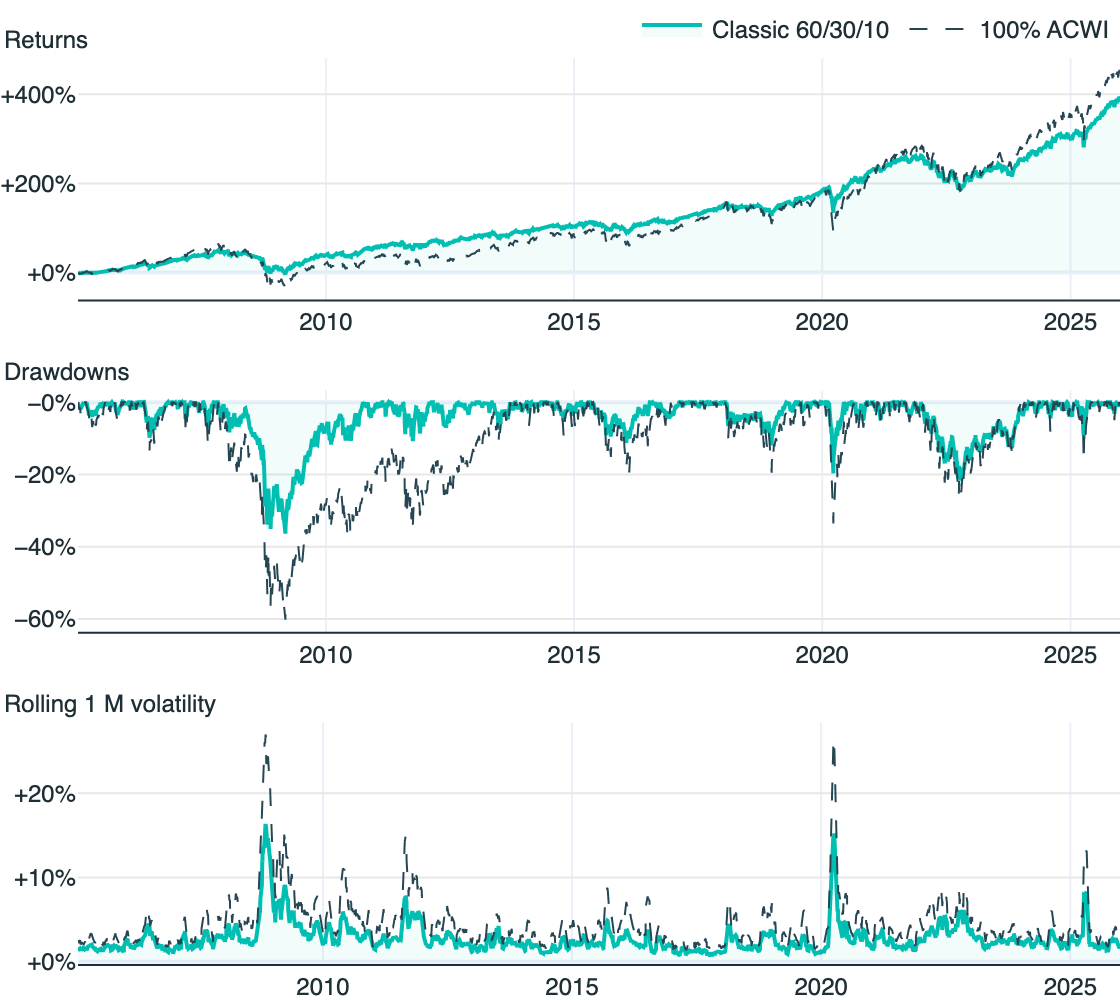
Classic 60/30/10 vs. 100% ACWI portfolio performance statistics, 2005 - 2025
Over the 2005-2025 period, the native 60/30/10 portfolio delivered +391% total return compared to +453% for 100% ACWI—a modest 14% lag in absolute terms. However, this came with substantially reduced risk: volatility of 11% versus 19%, maximum drawdown of -36% versus -60%, and peak one-month rolling volatility of 16% versus 27%. For many investors, this trade-off represents a compelling proposition.
The volatility-scaled version delivered +1,103% versus +453% for ACWI, with maximum drawdown of -55% versus -60%. The Sharpe ratio improved from +0.51 to +0.70, demonstrating meaningfully better risk-adjusted performance.
The inverse volatility portfolio
A more sophisticated approach weights assets by the inverse of their volatility—allocating more to stable assets and less to volatile ones. This mechanical rule produces a 58% IEF, 22% GLD, 20% ACWI allocation.

Inverse volatility vs. 100% ACWI portfolio performance statistics, 2005 - 2025
The native portfolio delivered +287% versus +453% for ACWI—a larger absolute return gap. However, the risk reduction was dramatic: volatility of 7% versus 19%, maximum drawdown of -18% versus -60%, and peak one-month rolling volatility of 7% versus 27%. This represents a fundamentally different investment experience—one where severe market crises barely register in portfolio value.
The volatility-scaled version delivered +3,372% versus +453% for ACWI. The Sharpe ratio reaching +0.95—nearly double the all-equity baseline. The improvement in risk-adjusted performance was substantial.
Both fixed allocation strategies demonstrate meaningfully better drawdown and tail risk characteristics than 100% equities, creating a smoother psychological journey aligned with the behavioural finance principles discussed earlier.
The challenge: prolonged asset class underperformance
Yet fixed allocation strategies carry an inherent vulnerability: any single asset class can underperform for remarkably long periods. Within our data, bonds delivered negative real returns throughout much of the 2010s as central banks suppressed rates. Gold languished for over nine years after its 2011 peak. Even diversified global equities endured drawdowns lasting over six years. When extended to specific markets, the picture is starker—Japanese investors experienced equity drawdowns spanning decades.
When a portfolio maintains fixed weights, it continues allocating capital to underperforming assets regardless of conditions. This disciplined diversification prevents performance-chasing behaviour but creates persistent performance drag during extended asset class underperformance.
This limitation raises a question: can adaptive allocation strategies, which adjust positions based on market conditions whilst remaining systematic, offer a better balance?
Adaptive allocation strategies—systematic flexibility
Fixed allocation portfolios maintain constant weights regardless of market conditions. Adaptive strategies adjust allocations systematically based on quantitative signals—not subjective judgement, but rules-based calculations that any investor can replicate.
Monthly optimisation across 4 ETFs
This strategy expands the basic equity/bond/gold framework by distinguishing between US and non-US equity exposure. The asset universe consists of four ETFs: IEF (US Treasury bonds), GLD (gold), EFA (developed markets ex-US equities), and IVV (S&P 500).
Each month, the portfolio calculates the maximum Sharpe ratio allocation using modern portfolio theory with a 48-month lookback window. This systematic optimisation determines allocations based on recent return patterns, volatility, and correlations, tilting towards assets exhibiting better risk-adjusted performance whilst maintaining diversification.
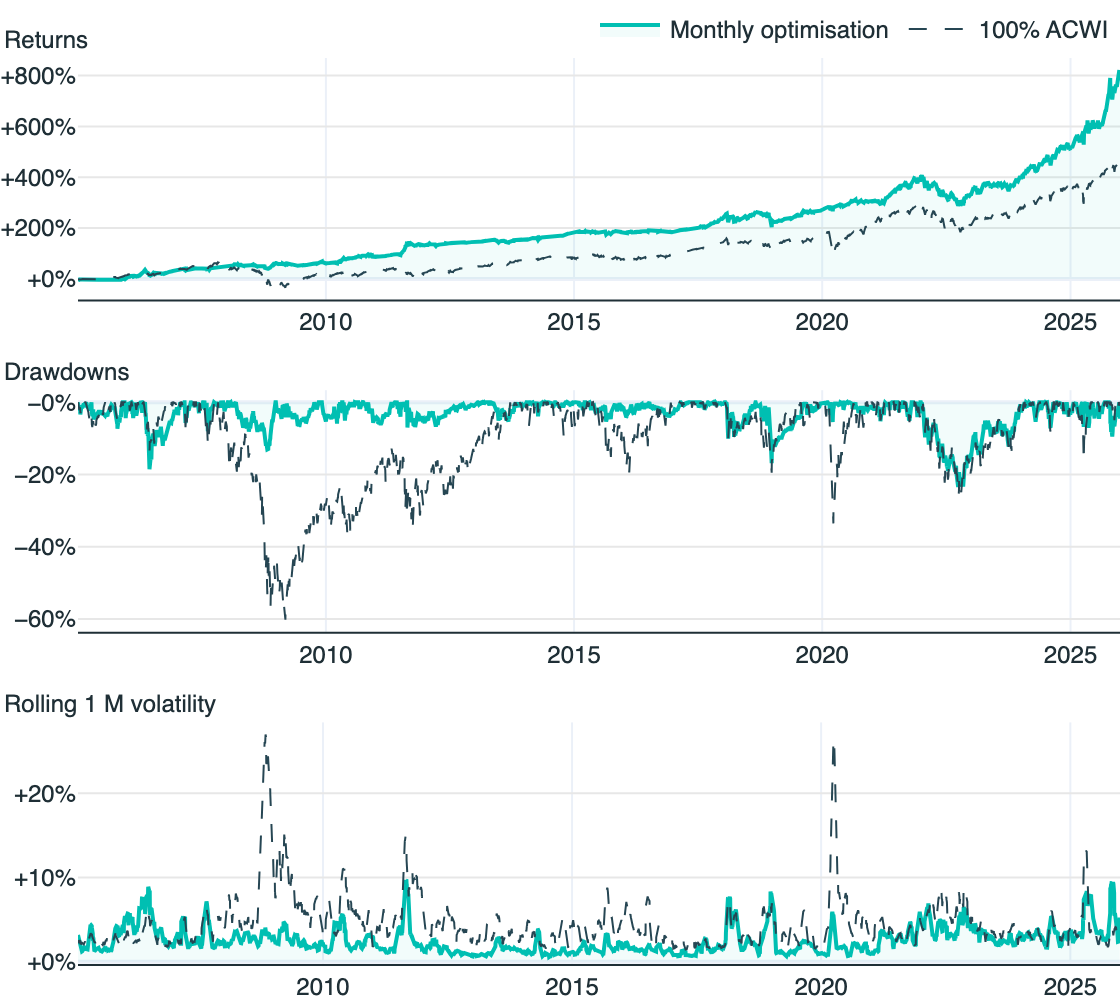
Monthly optimisation vs. 100% ACWI portfolio performance statistics, 2005 - 2025
The native portfolio delivered +786% versus +453% for ACWI over 2005-2025—substantially outperforming whilst reducing risk: volatility of 11% versus 19%, maximum drawdown of -23% versus -60%, and peak rolling volatility of 9% versus 27%. A genuine improvement on both dimensions.
The volatility-scaled version delivered +4,248% versus +453%. The Sharpe ratio reaching +1.01—double the all-equity baseline. By allowing allocations to shift through a transparent, repeatable process, the strategy captures tactical positioning benefits without requiring subjective market views.
Monthly selection and optimisation from 10 assets
The second adaptive approach expands the opportunity set to: GLD (gold), UUP (US dollar), EFA (developed markets ex-US), QQQ (Nasdaq-100), IVV (S&P 500), IEF (intermediate Treasuries), TLT (long-term Treasuries), EEM (emerging markets), BND (US aggregate bonds), and BNDX (international bonds).
The methodology operates in two stages. First, each month the portfolio selects the five assets with the highest Sharpe ratio over the trailing 12 months—a momentum-based filter identifying instruments exhibiting the best recent risk-adjusted performance. Second, it performs the same maximum Sharpe ratio optimisation, determining optimal weights among the selected five.
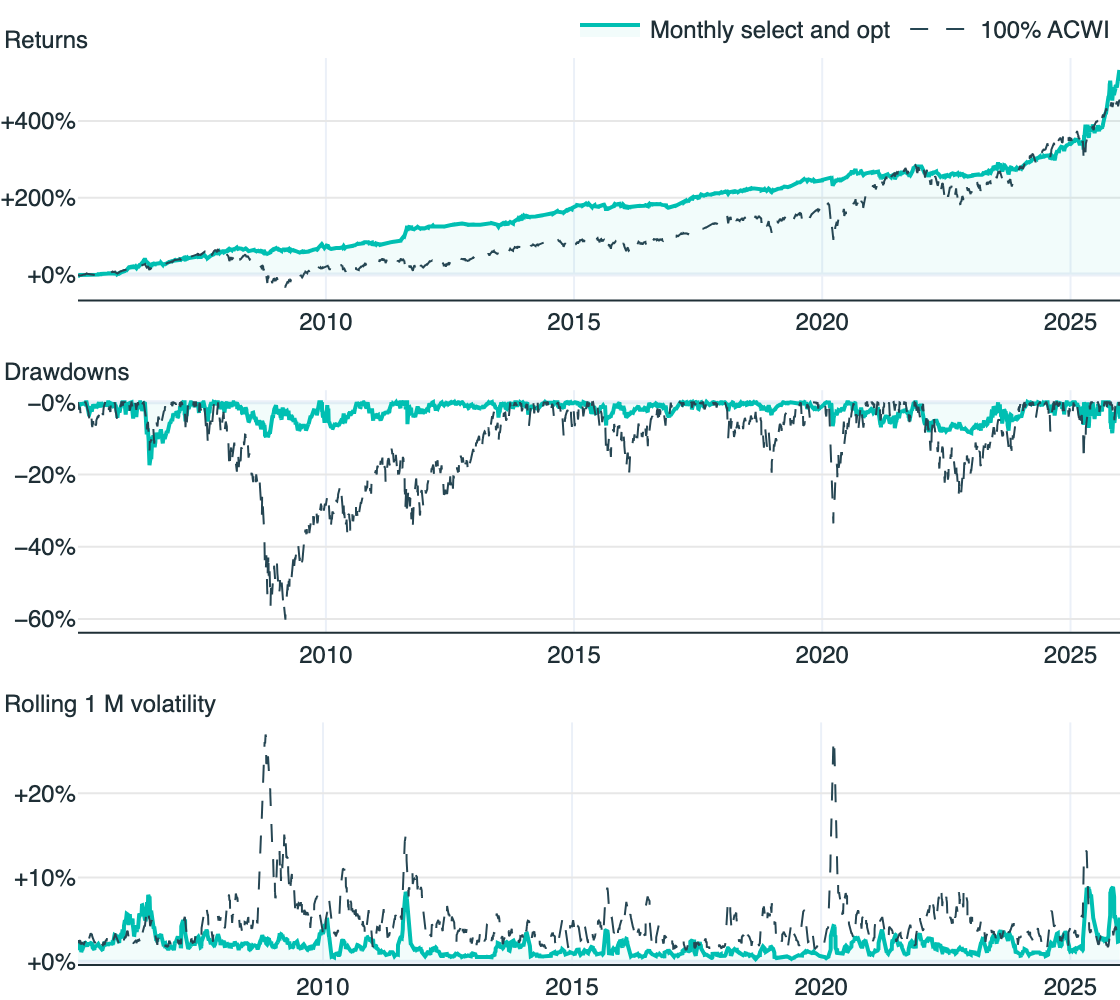
Monthly selection and optimisation vs. 100% ACWI portfolio performance statistics, 2005 - 2025
The native portfolio delivered +509% versus +453% for ACWI, with volatility of 8% versus 19%, maximum drawdown of -17% versus -60%, and peak rolling volatility of 9% versus 27%. This portfolio delivers higher returns whilst experiencing drawdowns less than a third as severe.
The volatility-scaled version delivered +5,670% versus +453%. The Sharpe ratio reaching +1.07—the highest of all strategies examined. By combining asset selection with allocation optimisation, the portfolio adapts dynamically to changing market regimes.
Greater sophistication, greater rewards
Adaptive strategies demand more than fixed allocation approaches: monthly rebalancing calculations, more frequent trading, and greater attention to portfolio mechanics. Yet this added complexity is rewarded with the strongest risk-adjusted performance of all approaches examined. Both adaptive strategies achieve Sharpe ratios above +1.0—double the all-equity baseline—whilst delivering substantially improved tail risk metrics and smoother investment experiences.
Finding the right systematic approach
The progression is clear: more sophisticated systematic approaches deliver meaningfully better risk-adjusted returns and smoother investment experiences across the 2005-2025 period. Sharpe ratios advanced from +0.51 for the 100% ACWI baseline to +1.07 for the 10-asset adaptive strategy, whilst maximum drawdowns and tail risk metrics improved substantially at each level of sophistication.
Yet the optimal choice depends on three critical factors: investment horizon, risk tolerance, and account constraints. Investors with decades until retirement and genuine temperament for volatility can succeed with simpler equity-heavy strategies. Those with shorter timeframes, lower risk tolerance, or psychological aversion to severe drawdowns benefit more from multi-asset approaches. Practical considerations also matter: transaction costs can erode benefits for smaller portfolios, whilst individual tax implications in taxable accounts can affect the attractiveness of frequent rebalancing. Trading restrictions on certain platforms may limit available options.
The decision ultimately balances risk-adjusted performance against operational complexity:
- 100% ACWI: maximum simplicity but highest volatility and deepest drawdowns
- Fixed allocation (60/30/10 or inverse volatility): minimal effort (annual rebalancing), substantial improvements over all-equity
- Adaptive strategies (4 or 10 assets): monthly attention and quantitative comfort required, strongest risk-adjusted performance
Neither approach is universally superior; the right choice aligns systematic rigour with individual circumstances.
For investors seeking to implement adaptive strategies, tools like pfolio offer pre-built portfolios employing the dual-layer process examined here: dynamic asset selection combined with systematic allocation optimisation. Users can also construct custom portfolios tailored to specific requirements. The key insight remains constant: systematic portfolio construction need not mean static allocation. Rules-based strategies can adapt to changing markets whilst eliminating the behavioural pitfalls that undermine discretionary trading.
After all, the portfolio that delivers exceptional returns over two decades only benefits the investor who maintains it for two decades. Systematic approaches that acknowledge psychological reality—not merely financial theory—give DIY investors their strongest foundation for long-term success.
Literature
Barber, B. M., & Odean, T. (2000). Trading is hazardous to your wealth: The common stock investment performance of individual investors. The Journal of Finance, 55(2), 773–806.
Benartzi, S., & Thaler, R. H. (1995). Myopic loss aversion and the equity premium puzzle. The Quarterly Journal of Economics, 110(1), 73–92.
Kahneman, D., & Tversky, A. (1979). Prospect theory: An analysis of decision under risk. Econometrica, 47(2), 263–291.
Disclaimer
Continue reading

Get started now


