



The DIY investor's handbook, part 3: from strategy to execution
The execution gap
Parts 1 and 2 of this handbook ended with the reader in an enviable position: a precise knowledge foundation, a broker that meets the bar, and a written investment policy statement that records every decision worth making in advance. On paper, the hard part is done. The evidence says otherwise.
Investors tend to earn less than the investments they hold. The shortfall has a name—the investor return gap—and a simple mechanism: because investors add and withdraw capital at the wrong moments, buying after strong runs and selling after sharp falls, the return on the average invested dollar trails the return of the assets themselves. Morningstar has measured this gap annually for close to two decades. Its most recent study finds that over the 10 years to December 2024 the average dollar invested in US funds earned 7.0% a year against the funds' own 8.2%—a gap of 1.2 percentage points, and one broadly consistent across editions. The precise magnitude is debated, and credible work argues the timing penalty is smaller than the headline numbers imply. But the direction is not in dispute, and it points the same way as a deeper body of evidence. Barber and Odean, studying 66,465 households at a US discount broker over 1991–1996, found that the most active traders earned 11.4% a year while the market returned 17.9%—a punishing gap, attributable to trading itself. Dichev (2007) found the same pattern in the dollar-weighted returns of entire stock markets. The studies differ in method and in the size of the effect they measure; they agree on its sign. Acting on judgement, in the moment, costs money.
The strategy, in other words, can be sound and the outcome still poor. What sits between the two is execution, and execution leaks in two distinct ways.
The first leak is behavioural: large, episodic, and expensive. Capital added after markets have already risen. Contributions paused during drawdowns—at precisely the moments they would have bought cheaply. Positions sold near the bottom by an investor who, eight months earlier, calmly declared a high risk tolerance. This is the leak the studies above measure, and it is where the largest costs sit.
The second leak is frictional: small, constant, and easy to ignore. Spreads paid unnecessarily because every order goes in at market. Foreign exchange converted carelessly. Cash sitting idle between a sale and the purchase it was meant to fund. No academic study aggregates these costs, and none is needed—they are arithmetic. For an investor rebalancing a portfolio of liquid ETFs once a month, each individual instance is genuinely small. But they recur every single cycle, for decades, and they compound with the same indifference as the fees dismantled in part 1.
Both leaks close the same way. Not through better judgement in the moment—part 2 established at length why in-the-moment judgement is the problem—but by removing the moment altogether. Execution, done well, is not a series of decisions. It is a system: designed once, in calm conditions, then run on schedule, identically, in quiet months and loud ones. The behavioural leak closes because the system does not consult your mood before acting. The frictional leak closes because even the smallest mechanical steps follow rules instead of reflexes. Neither win is dramatic on any given day. The entire premise of systematic investing is that it does not need to be—small advantages, applied consistently, accumulate exactly as small losses otherwise would.
That is what this final part of the handbook builds: the system that turns the IPS from a document into a practice. Its shape is easiest to see as a set of clocks. Some decisions are made once: which instruments are eligible, and by which rules trades are placed. One is made once, as an event: moving the starting capital to target weights. One recurs monthly: the rebalancing routine—the layer where consistency does its compounding. Two run annually: the honest review of how the portfolio is doing, and the slower review of whether the strategy still fits the life it serves. And one clock is deliberately absent: nothing in the system runs on market news. The design intent is the same throughout—push every decision onto the slowest clock it can live on, because the less often a decision must be made, the better the conditions under which it is made. The article proceeds clock by clock, from the decisions made once to the ones that never stop.
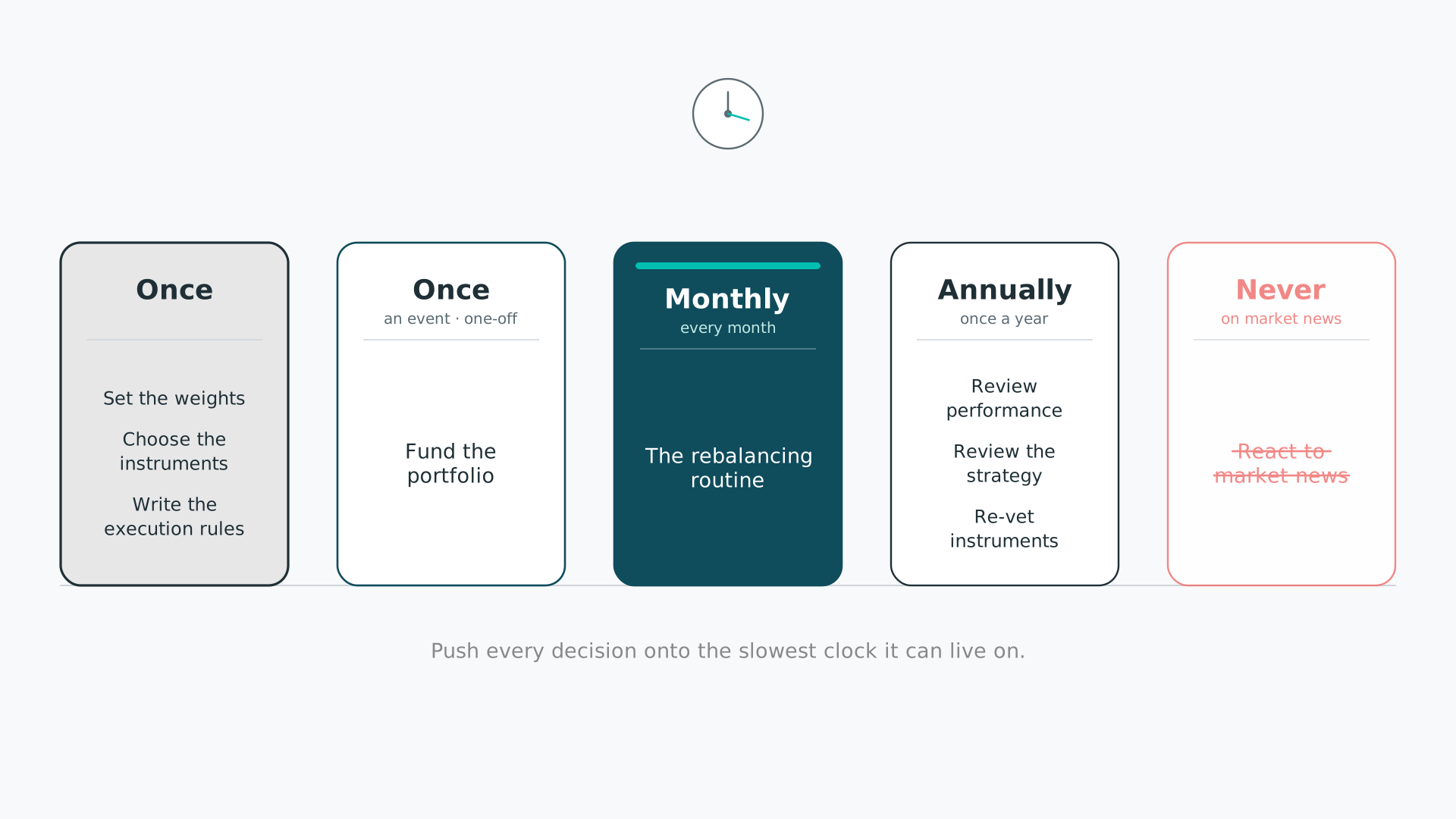
The execution system as a set of clocks: each decision pushed onto the slowest clock it can live on—once, as an event, monthly, annually, never on market news
From universe to instruments
The IPS deliberately stops one level above the portfolio. It defines what is eligible—asset types, asset classes, geographies, exclusions—and leaves open which assets are held and at what weight. That was the point: the policy outlives any particular implementation. But it means that between the document and the first trade sit two translation steps. The first decides how the eligible universe becomes a set of target weights. The second decides which instruments implement them. Both are decisions made once—the slowest clock in the system, and the right place to spend real care, because the conclusions hold for years.
Setting the weights
There are three broad levels at which the eligible universe becomes a set of weights, set out in Beyond buy and hold and rising in sophistication: single-index investing, holding one broad global equity ETF at a permanent 100%; fixed allocation, a static set of weights across several asset classes—a classic 60/30/10, or a rule-based variant such as inverse-volatility weighting—rebalanced to target on schedule; and adaptive allocation, weights recalculated each period by a quantitative rule, responding to changing conditions without discretionary judgement. The weights can be one's own or adopted from a published model; that is convenience, not a separate tier. None of this is the subject of this article—the linked piece makes the comparative case—and it does not need to be, because the execution system that follows is identical regardless of which level sets the weights. What matters here is only that the level is chosen consciously, matches the management style committed to in the IPS, and produces, each period, an unambiguous set of target weights. Everything that follows consumes that output.
Choosing the instruments
What instrument selection produces depends on the level. For single-index investing or a fixed allocation, the output is a one-to-one list: each exposure, one instrument. For an adaptive strategy, the output is an instrument universe: a vetted pool of candidates—typically larger than the portfolio will ever hold at once—from which the rules select and weight a subset each rebalancing period. In that case the monthly selection is not a re-vetting; it is the system running. Vetting happens here, once, for every instrument that enters the pool.
In either form, for most DIY investors this means choosing among ETFs—and ETFs that appear interchangeable at first glance can differ meaningfully on closer inspection. Two funds tracking 'global equities' may hold different indices, distribute income differently, sit in different jurisdictions, and cost different amounts in ways the headline fee does not capture. The comparison is a checklist, not a judgement call, and it has eight dimensions.
The index. The single largest determinant of what a fund does is the index it tracks, not the fund itself. Two world-equity indices can differ materially in their treatment of small caps, emerging markets, and currency. Before comparing funds, confirm the index delivers the exposure the target weight calls for.
Total expense ratio. The headline annual cost, charged inside the fund. Directly comparable across funds and relentlessly compounding—but, as the next dimension shows, not the full story.
Tracking difference. The honest cost measure: the gap between the fund's actual return and its index's return over a period. It captures the TER plus everything the TER hides—replication efficiency, securities-lending revenue, internal trading costs, and the fund's withholding-tax experience on the income it receives. A fund with a higher TER and a smaller tracking difference is cheaper in every sense that matters. Multi-year tracking difference, where available, beats the fee table.
Liquidity and spread. The cost of getting in and out. For large funds tracking major indices, bid-ask spreads are typically negligible; for smaller or more specialised funds, they are a real and recurring cost paid at every rebalance. Average spread and daily trading volume are both worth a look—this is where instrument selection and the execution rules of the next section meet.
Fund size. Small funds carry closure risk: a fund that fails to gather assets may be liquidated or merged, forcing a sale at a time not of your choosing. Size also correlates with tighter spreads and lower tracking difference. There is no magic threshold, but persistent smallness is a flag.
Replication method. Physical replication holds the index's securities; sampling holds a representative subset; synthetic replication holds a swap that delivers the index return. Each is a legitimate structure with different trade-offs—sampling can drift from the index, synthetic structures carry counterparty exposure and disclosure worth reading—and the method is stated plainly in every fund's documentation.
Distribution policy. Accumulating funds reinvest income internally; distributing funds pay it out. The mechanical difference is workflow—distributions create cash that must be reinvested by hand—but the consequential difference is often tax treatment, which varies by jurisdiction and belongs to the final dimension.
Domicile and tax. Where a fund is legally based determines the withholding tax it suffers on the income it receives, the regulatory regime it operates under, and which investors may buy it at all. How the investor is then taxed—on distributions, on accumulation, on eventual sale—depends on their own country of residence, applicable treaties, and account structure. Both layers materially affect net returns, and neither has a universal answer: a domicile that is efficient for one investor's residence can be inefficient for another's. This handbook does not give tax guidance—the right choice is jurisdiction-specific, and a qualified tax adviser is the appropriate source. What the framework requires is only that the question is asked deliberately, for each instrument, before it enters the list.
In practice these dimensions usually converge, and the decision is simpler than eight criteria make it sound. Once domicile and distribution policy are fixed to suit your residence and workflow—the two choices only you can make—a reliable default settles most of the rest. The remaining dimensions are tie-breakers and red flags—a synthetic structure to read the disclosure on, a fund too small to trust—rather than independent decisions.
This produces the article's first artefact: a concrete instrument list or universe, every entry chosen on evidence. It is not part of the monthly cycle—but it is not immutable either. The fund landscape is a competitive market: providers cut fees, launch better-structured alternatives, merge funds, and occasionally close them. The instrument that was the clear choice for an exposure five years ago may be second-best today. The list therefore earns a periodic review of its own—a natural companion to the annual IPS review from part 2—plus an event-driven one whenever a held fund announces a closure, changes its fee, or shows persistent tracking deterioration.
Takeaway: among funds that cleanly track the exposure you want, take the largest with the lowest tracking difference—size brings tighter spreads and lower closure risk, tracking difference is the true cost, clean exposure is the point. The cheapest large fund tracking the right index in the right domicile is usually the answer. Revisit the choice on a schedule, not every month.
Execution rules
Of all the decisions in an investor's process, how an order is actually placed receives the least thought. The strategy may have taken weeks of deliberation; the trade that implements it takes one reflexive click on the market order button. That asymmetry is worth pausing on—not because the click is catastrophic, but because it is a decision like any other, made dozens of times a year, for decades. This too is a decision made once: the rules are set now, written down, and then simply followed at every trade. Execution rules are the smallest application of that principle.
What a trade actually costs
A trade has two costs. The commission is the visible one—it appears on the statement, and part 1 dealt with it when choosing the broker. The spread is the invisible one: the gap between the price at which the market buys and sells, of which an order pays some share depending on how it is placed. A plain market order takes whatever the market offers and typically pays the full half-spread. A limit order placed at the midpoint waits, and often fills at no spread cost at all—accepting, in exchange, the risk of not filling and having to try again. Broker-hosted order algorithms sit between the two, trading patience for certainty in various ratios.
Which approach is worth the effort depends almost entirely on how wide the spread is. On large funds tracking major indices, spreads are measured in fractions of a basis point to a few basis points—at that level, sophistication barely pays, and simplicity is a defensible rule. On smaller funds, less liquid markets, and anything traded outside its home market's main hours, spreads widen to the point where patience has a measurable return. The logical structure of an execution rule therefore looks like a small decision tree: classify the order by the spread on screen, apply the strategy assigned to that band, and—because patient orders sometimes fail to fill—define in advance what happens next, ending in an order type that always executes. The fallback chain matters as much as the first choice: an investor improvising after an unfilled limit order is back to deciding in the moment, which is the failure mode the rule exists to prevent.
None of this is theoretical. We measured it: pfolio's order execution costs tool records the realised cost, in basis points, of four order strategies across asset classes—measured on live broker fills rather than lifted from fee tables, with the harness and data open-source for anyone who wants to reproduce the numbers against their own broker. The point of the tool, for this article, is not the specific policy it describes—order-type menus differ by broker, and the right chain depends on what yours offers. The point is the demonstration: even order placement, the step most investors consider beneath deliberation, turns out to be measurable, rule-able, and cheaper when approached systematically. The differences per trade are small. They are also free, and they recur every cycle.
The rest of the rulebook
Order strategy is the largest entry in the execution rulebook, but not the only one. A handful of further rules close the remaining frictional gaps, and each takes one line to write down. When to trade: spreads are widest at the open and unsettled at the close; mid-session is the dull, correct default, and instruments traded far from their home market are cheapest during overlapping hours. Currency conversion: instruments in foreign currencies require an explicit FX step—convert deliberately, once per cycle, rather than letting the broker convert implicitly per trade at whatever rate applies. Rounding and residual cash: target weights rarely divide into whole shares; round consistently, in the same direction, and give the leftover cash a standing destination so it does not accumulate as silent drag. Records: note what was traded, when, and at what price—thirty seconds per order, and the raw material the monitoring layer runs on.
Written out, the entire rulebook fits on half a page, and it belongs with the IPS—an operational appendix to the policy document part 2 built. Its value is not any single entry. It is that one more layer of the process now runs without consulting your judgement on the day, which is exactly the condition under which judgement is least reliable.
Takeaway: match the order to the spread—on tight spreads a market order is fine; as spreads widen, patience pays. Write down the fallback for an unfilled order in advance, so you never improvise mid-trade. The edge per trade is small, but it is free and it recurs forever.
The first—and hardest—test of that machinery comes immediately: putting the starting capital to work.
The first execution: funding the portfolio
Everything so far has been preparation: weights, instruments, rules. The first time the machinery actually runs is the largest trade you will ever place—moving the starting capital from cash to target weights. It happens once, as an event, and it arrives with maximum emotional exposure. Markets feel expensive, or fragile, or both; the urge to wait for a better moment is strongest precisely when the most money is at stake. It helps to see this event for what it is: not a special occasion that precedes the system, but the first iteration of the same rebalancing process you will run every month thereafter. Iteration one is simply the version where the distance between current and target weights is total.
Part 2 required the IPS to pre-commit to a funding plan: deploy as a lump sum, or phase in over a defined schedule. The evidence on that choice is clear. Because markets rise more often than they fall, deploying immediately has historically beaten phasing in roughly two thirds of the time—a result Vanguard found across the US, UK, and Australian markets, and one that holds after adjusting for the higher risk of being fully invested. Cash on the sidelines has an expected cost. Phasing is therefore not the statistically superior strategy; it is insurance against regret, paid for in expected return. That can still be the right purchase. An investor who would abandon the strategy entirely after deploying everything the week before a 20% fall has bought something real with that premium. The dishonest version is phasing without a schedule—'I will invest more when things look better'—which is market timing wearing prudence as a costume. The rule, either way, is the one part 2 wrote: whichever plan the IPS chose executes on its dates, mechanically, with the urge to deviate handled by the deviation protocol rather than by the calendar quietly slipping.
Many readers, though, do not arrive holding cash. They arrive holding a robo-advisor account here, cryptocurrency on an exchange there, a handful of individual stocks at a broker—the fragmented portfolio this handbook has met before. For them the first execution is a migration, and it starts with a mapping exercise: set every existing position against the target portfolio. Some holdings fit—an ETF already in the instrument universe simply stays and counts toward its weight. Everything else is the funding question in different clothes, with two additions. The first is mechanical: exit costs, transfer fees, and the practicalities of closing accounts belong in the plan. The second is behavioural, and it is the one that quietly wrecks migrations: the legacy position held 'until it recovers'. A holding that you would not buy today, at today's price, with today's information, has no claim to its place in the portfolio—what it cost you once is not information about what it will do next. Loss aversion makes that sentence easy to read and hard to act on, which is exactly why the migration belongs in a written plan with dates, not in a sequence of monthly judgement calls. One factual note applies in both directions: selling existing positions can realise taxable gains or losses depending on jurisdiction and account structure, which is a question for a qualified tax adviser, not for this article—and not a reason to leave a portfolio misallocated indefinitely.
However the capital arrives, the first execution ends in the same place: a portfolio at target weights, every position one the strategy chose.
Takeaway: deploy on the schedule the IPS already chose—lump sum or phased—and do not renegotiate it now. Phasing is regret insurance, not a better return. If you are migrating existing holdings, keep what fits the target and sell the rest; a position you would not buy today has no claim to its place, whatever it once cost.
From here on, nothing new happens. The system simply repeats—which is the entire point, and the subject of the next section.
The routine
This is the monthly clock—the only part of the system the investor actually lives inside, and the layer where everything built so far pays out. Its content is deliberately undramatic. On a fixed date each month: obtain the period's target weights—constant for a static allocation, freshly calculated for a systematic strategy (this is where the month's selection and allocation arrive); compare them against current holdings; translate the differences into a trade list; execute that list under the rules of the execution rulebook; record what was done; close the laptop. Time-boxed, a couple of hours, done. For most of the year, the routine is boring. It is supposed to be—boredom is what a system feels like from the inside.
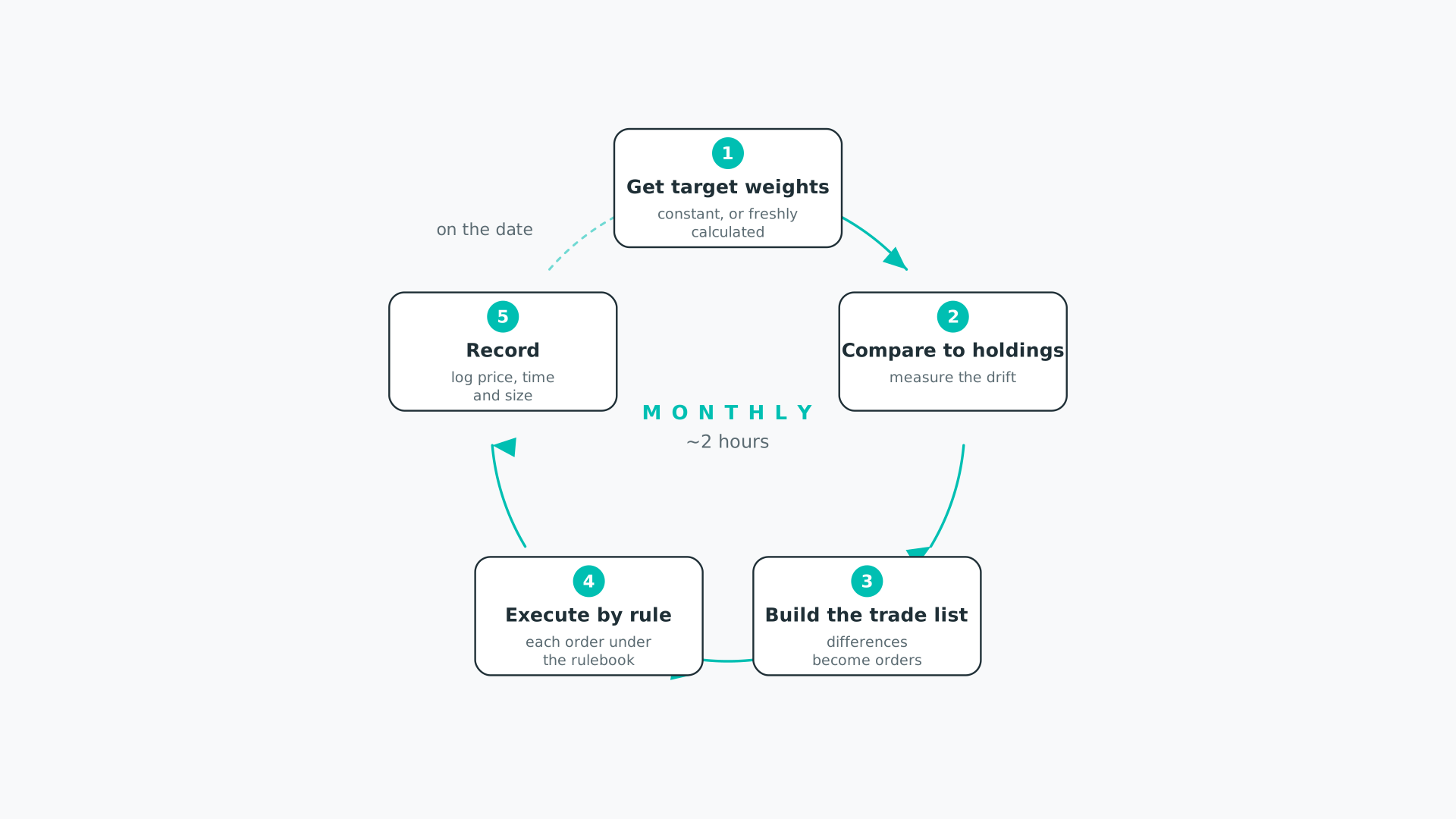
The monthly routine as a loop: targets in, trades out, records kept—the same steps in every market condition
Two design choices carry the routine's entire value, and both are easy to underestimate. The first is that it runs on the calendar, not on the market. The date triggers the cycle; nothing else does. Tolerance bands—rebalancing only when an allocation drifts past a threshold—are a legitimate alternative cadence for static portfolios and can reduce unnecessary trading, but they reintroduce a monitoring obligation and a judgement call about when drift 'counts'. For a systematic monthly strategy the question dissolves: the calendar is the band. The second is that the routine is identical in every market condition. A month in which markets fell 3% and a month in which they fell 23% contain exactly the same steps. This is not stubbornness; it is the design. The system's responsiveness to markets—if the strategy is adaptive—lives inside the target weights, where it was decided in advance. It does not live in whether the routine runs.
New capital enters the same way. A contribution is not a purchase decision; it is cash that joins the pot before the next cycle and gets allocated by the same process as everything else. The alternative—buying 'something' with each contribution as it arrives—reopens a monthly judgement call the system exists to close, and tends, in practice, to buy whatever has recently performed well. The funding plan in the IPS set the contribution schedule; the routine is where it lands.
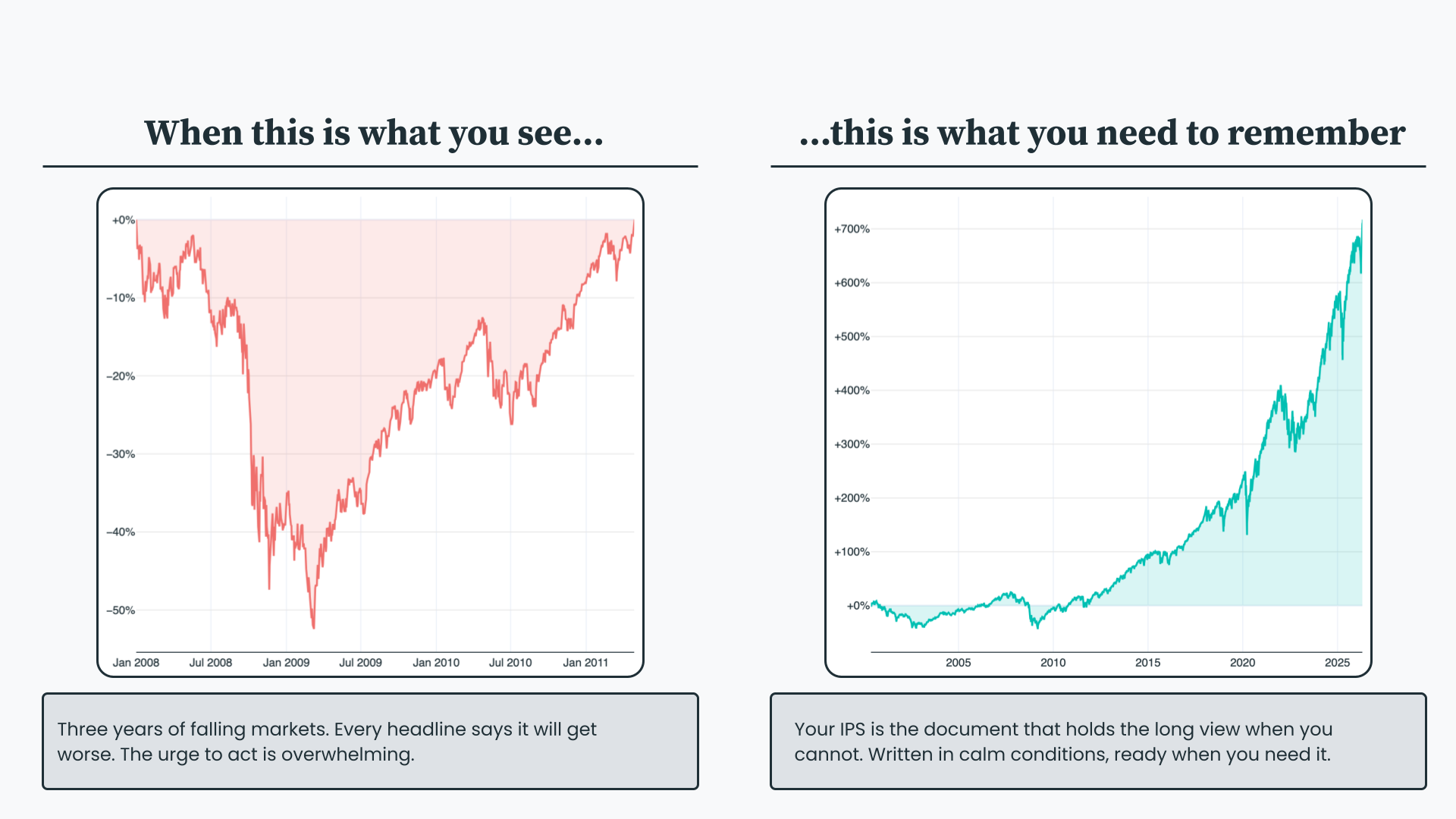
Then there is the month the routine earns its existence. At some point—the only uncertainty is when—the cycle date will arrive in a drawdown deep enough that running the process feels reckless. The instructions will say to buy the thing that has been falling. Every headline will explain why this time is different. This is the moment the entire handbook has been building toward, and the answer it gives is almost anticlimactic: run the routine. The weights already reflect everything the strategy knows; the urge to override them is precisely the in-the-moment judgement whose track record part 2 documented. If the urge persists, it has a designated outlet—the deviation protocol, with its written case and its mandatory delay—rather than a quiet skipped month. A skipped cycle is not a pause; it is a discretionary decision to hold the current portfolio, made at the worst possible moment, by the least reliable version of you.
None of this requires any particular tooling—a spreadsheet and a calendar reminder are a complete implementation. It is, for transparency, also exactly the cycle pfolio's Investments product operationalises: target weights in, structured trading instructions out, holdings tracked against targets. Use whichever implementation you will actually keep running; the system's value is in the keeping, not the tooling.
Takeaway: run the routine on a fixed date, the same way, every month—including, above all, the month it feels reckless to. The routine does not change in a crisis; that is the whole design. A skipped cycle is not a pause, it is a discretionary bet made at the worst possible moment.
Tracking and monitoring
Rebalancing is acting; monitoring is knowing. The two are easy to conflate and the conflation is itself a failure mode: an investor who checks the portfolio daily is an investor accumulating reasons to act between cycles. Monitoring runs on its own clock—largely annual—and the deliberately uncomfortable answer to 'how often' is: less than feels natural.
Two things are worth tracking, on two different schedules. Allocation drift—holdings against targets—is checked monthly, inside the routine, where it is mechanical input rather than judgement. Performance is reviewed formally once a year, and against the right yardstick: the strategy as designed—its own target composite—not the loudest index of the season. A multi-asset portfolio measured against the S&P 500 in an equity bull market will look like a failure by construction; that comparison is how sound strategies get abandoned, and part 2's trade-offs section exists precisely so the review can ask the only fair question: is the system doing what it was designed to do, drawdowns and all? The annual cadence is not laziness—it is Benartzi and Thaler's finding made operational: the more frequently returns are evaluated, the more losses dominate the experience and the more likely the strategy is abandoned. Look on schedule, never on news.
The records the routine produces are the raw material here—every trade, every cycle, in one ledger. For investors whose holdings span several accounts, that consolidated ledger is also the only place their actual allocation and risk exposure exist at all. Its annual output is an evidence file, and the evidence file has exactly one customer: the review on the slowest clock of all.
Takeaway: check drift monthly inside the routine; judge performance once a year, against your own strategy's design, never against the loudest index of the season. Looking more often does not help—it only multiplies the chances of an unforced error.
The strategy over time
The system is stable; the life around it is not. On the annual clock, alongside the performance review, sits a second question: does the strategy still fit? Horizons shorten, income changes, dependants arrive, objectives drift from growth toward preservation—and each of these is a legitimate reason for the strategy itself to change. The route is the one part 2 built and this article will not re-litigate: changes flow through the annual IPS review, as deliberate, scheduled revisions—life changes the document; markets do not. The annual review is also where the instrument universe from earlier in this article gets its scheduled inspection: providers will have cut fees, launched alternatives, merged and closed funds, and a universe vetted once deserves re-vetting on the same calendar.
One change deserves naming because it is larger than a revision: eventually, accumulation ends. Drawing a portfolio down is a different discipline from building one—withdrawal rates, the risk that early losses do disproportionate damage, de-risking toward a date, and rules that vary heavily by jurisdiction and account type. This handbook covers the building. Decumulation deserves the same deliberate treatment, in its own right, and pretending the system above answers it would be the only dishonest sentence in three articles. What the system does guarantee is the position you arrive with: a portfolio whose contents you can explain, records that show how it got there, and a decade or more of practice at changing strategy deliberately rather than reactively. That is the right starting capital for the next discipline too.
Takeaway: let life change the strategy, never the market. Route every change through the annual review as a deliberate revision—and re-vet the instrument list on the same calendar, because the fund landscape moves even when your plan does not.
The handbook, complete
This handbook opened, three articles ago, with an investor standing between paralysis and action bias, unsure what to learn first. It closes with something specific: a knowledge foundation that knows its own boundaries, a broker chosen on evidence, a written policy that decided everything decidable in advance—and now the system that executes it. The two leaks the opening named are both sealed: the behavioural one by a routine that runs regardless of mood, the frictional one by rules that govern even the smallest mechanical step. The pieces form a loop. The routine generates records; the records feed the annual review; the review maintains the policy; the policy governs the routine. Every step runs on a clock, and no step runs on a forecast, a headline, or the willpower available on a difficult day.
Notice what the finished system never asks of its owner. It never asks for a market view. It never asks for courage at the bottom or restraint at the top—those were purchased in advance, in calm conditions, and stored in documents. What it asks for is smaller and harder: showing up, on the date, every month, for decades, when nothing about doing so feels urgent or clever. That is why this final part has insisted on the unglamorous words—routine, rulebook, ledger, schedule. DIY investing fails far more often as a lapsed habit than as a wrong strategy.
So the handbook's last reframe is its simplest. Managing your own investments is not a project with a completion date. It is a practice—maintained the way any practice is, through cadence rather than intensity. Markets will supply the volatility and the time. The system supplies everything else, except the one input it cannot generate: you, at the laptop, on the date. Close the loop each month, and let it compound.
Literature
Barber, B. M. & Odean, T. (2000). Trading is hazardous to your wealth: the common stock investment performance of individual investors. The Journal of Finance, 55(2), 773–806.
Benartzi, S. & Thaler, R. H. (1995). Myopic loss aversion and the equity premium puzzle. The Quarterly Journal of Economics, 110(1), 73–92.
Dichev, I. D. (2007). What are stock investors' actual historical returns? Evidence from dollar-weighted returns. American Economic Review, 97(1), 386–401.
Keswani, A. & Stolin, D. (2008). Dollar-weighted returns to stock investors: a new look at the evidence. Finance Research Letters, 5(4), 228–235.
Morningstar (2025). Mind the Gap: a report on investor returns in the United States (10 years to 31 December 2024).
Shtekhman, A., Tasopoulos, C. & Wimmer, B. (2012). Dollar-cost averaging just means taking risk later. Vanguard Research.
Disclaimer
Get started now


