



Calmar ratio: measuring portfolio returns against maximum drawdown risk
A portfolio's annual return tells only part of the story. The Calmar ratio completes it: annual return divided by maximum drawdown, producing a single figure that captures how much performance was generated per unit of the worst peak-to-trough loss an investor had to absorb. It is a direct test of whether a strategy's gains justified the pain of its declines.
What the Calmar ratio measures
The Calmar ratio was introduced by Terry W. Young in the 1991 edition of Futures magazine as a performance measure specifically designed for managed futures and commodity trading advisers, where drawdown tolerance is a primary investor concern. The name is an acronym of the publication that carried it: California Managed Accounts Reports. It has since been adopted across asset classes as a concise way to evaluate whether a strategy’s return compensates for its worst-case loss experience.
The Calmar ratio puts return and extreme downside risk on a single number. It takes the compound annual growth rate (CAGR) and divides it by the absolute value of the maximum drawdown—the worst peak-to-trough decline over the measurement period. The result expresses how much annualised return was earned per unit of maximum loss sustained.
A higher Calmar ratio is better: it means more return per unit of extreme risk. A portfolio with a 10% CAGR and a maximum drawdown of 20% has a Calmar ratio of 0.5. A portfolio with the same CAGR and a maximum drawdown of 40% has a Calmar ratio of 0.25. Same return, twice the pain—the Calmar ratio makes this visible immediately.
Like the Sharpe ratio for volatility, the Calmar ratio is most useful as a comparative tool: ranking strategies, evaluating whether one portfolio offers better risk-adjusted return than another, or assessing whether a portfolio's risk profile has improved or deteriorated over time.
The formula
Calmar = CAGR / |MDD|
Where:
- CAGR = compound annual growth rate
- MDD = maximum drawdown (a negative value; absolute value is used in the denominator)
- The formula uses the absolute value of maximum drawdown to produce a positive ratio. A CAGR of 0.09 (9%) divided by an absolute maximum drawdown of 0.30 (30%) gives a Calmar ratio of 0.30.
How to interpret the Calmar ratio
There is no universal threshold for a 'good' Calmar ratio—it depends on asset class, strategy type, and market environment. As a rough reference, a ratio above 0.5 is generally considered respectable for a diversified portfolio; above 1.0 is strong. Trend-following strategies, which are designed to limit drawdowns, often target ratios in the 0.5–1.0 range over full market cycles.
The Calmar ratio is particularly useful for comparing strategies that target different risk levels. A low-volatility portfolio may have a lower CAGR than an aggressive equity strategy, but if its maximum drawdown is also materially lower, its Calmar ratio may be higher—meaning it delivered its return more efficiently from a drawdown perspective.
A common misinterpretation is to read a high Calmar ratio as a sign of low risk in absolute terms. A high ratio means the return was good relative to the worst historical decline—it does not mean the portfolio had no significant drawdowns. A 15% CAGR against a 30% maximum drawdown gives a Calmar ratio of 0.5, which is reasonable; but 30% is still a substantial loss for an investor to absorb in practice.
Rolling Calmar ratio
The scalar Calmar ratio summarises the full measurement period. Rolling Calmar ratio computes the same metric over a sliding window, showing how the ratio has evolved through different market environments. Each point on the rolling chart answers the question: what was the Calmar ratio—CAGR relative to maximum drawdown—over the past n years ending on this date?
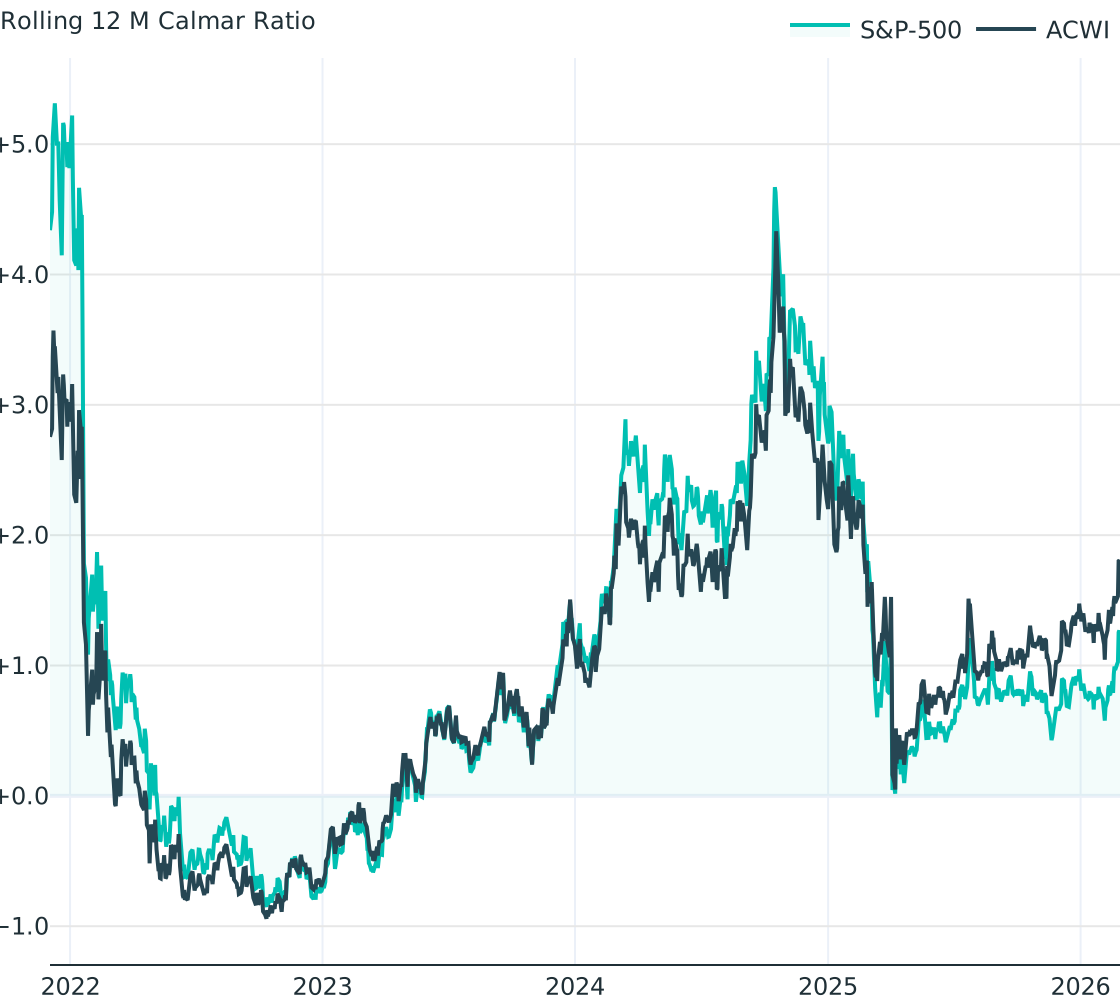
Rolling 12 M Calmar ratio: S&P-500 vs. ACWI
This view reveals whether a strategy's risk-return efficiency has been consistent or variable. A strategy that shows a high Calmar ratio in bull markets but a sharply lower ratio during bear markets may be less genuinely defensive than its full-period figure suggests. Conversely, a strategy with a modestly above-average but stable rolling Calmar ratio through different regimes is demonstrating consistent risk management.
Rolling Calmar ratio is available in the pfolio app.
Limitations
The Calmar ratio depends heavily on the period observed. A longer measurement period is more likely to include a severe bear market, producing a larger maximum drawdown and compressing the ratio. Two otherwise identical strategies measured over different periods—one that includes 2008, one that does not—may show materially different Calmar ratios. Always note the period when citing this metric.
Because maximum drawdown is backward-looking, the Calmar ratio reflects only the worst decline that has occurred in the observed history. Future drawdowns may be deeper, which would change the ratio—potentially dramatically. A high Calmar ratio based on a benign historical period should be interpreted with appropriate caution.
The Calmar ratio is also silent on the duration of drawdowns. A portfolio that recovered from its maximum drawdown in two months and one that spent three years underwater may show identical Calmar ratios. Recovery time is a material dimension of investor experience that this metric does not capture.
Calmar ratio in pfolio
In pfolio, the Calmar ratio is calculated on time series price data. By default this uses the close price; switching to adjusted close—which accounts for dividends and splits—can be configured via advanced settings. The choice of price series affects the result, particularly for dividend-paying assets over long periods. See time series data and metric types for a full explanation.
The Calmar ratio and its rolling equivalent are available in the pfolio app. For a full description of how pfolio calculates this and all other metrics, see the metrics we use.
Related metrics
Disclaimer

Get started now


