



Maximum drawdown: the essential measure of portfolio risk and loss
Maximum drawdown is the largest peak-to-trough decline an investment has experienced over a given period. It captures the worst-case loss that a long-term holder would have faced—the single most useful measure of downside risk for investors who think about portfolios over years, not days.
What maximum drawdown measures
Maximum drawdown is the most widely used single measure of an investment’s worst-case loss experience. Its statistical properties were examined in depth by Magdon-Ismail and Atiya (2004) in Maximum Drawdown, Risk Magazine, which derived its distribution under various return assumptions. In practice, maximum drawdown has become a standard component of manager due diligence and strategy evaluation precisely because it captures the tail of the loss distribution in a single, investor-interpretable number.
Maximum drawdown answers a direct question: what is the worst decline this investment has ever experienced from a peak to a subsequent trough? It searches the entire price history, finds the deepest fall from any high point to the lowest subsequent value, and returns that decline as a percentage of the peak.
The metric takes a price series as its input and produces a negative decimal (or zero in the theoretical case of no decline). A maximum drawdown of −0.35 means the investment fell 35% from its worst peak-to-trough period. Because it captures the single worst episode in the history observed, it is a backward-looking summary of extreme loss, not an average.
In pfolio, maximum drawdown is a 'higher is better' metric, where 'higher' means closer to zero. A maximum drawdown of −8% is strongly preferable to −45%: the first portfolio has never experienced a severe sustained decline; the second has. For long-term investors, tolerating a maximum drawdown is not just a numerical exercise—it is an emotional and behavioural test. Portfolios that stay within drawdown levels an investor can hold through tend to produce better outcomes than theoretically superior strategies abandoned under pressure.
The formula
MDD = mint(Pt / maxs ≤ t Ps − 1)
Where:
- MDD = maximum drawdown
- Pt = price at time t
- Ps = price at an earlier time s
For each point in time, the formula computes the ratio of the current price to the highest price recorded up to that point, then subtracts one to get the drawdown at that moment. Maximum drawdown is the minimum (most negative) value of this drawdown series across all time points—the single deepest trough across the entire history.
How to interpret maximum drawdown
Maximum drawdown is most meaningful when considered alongside return metrics. A portfolio that delivered a 12% CAGR over ten years with a maximum drawdown of −18% is a very different proposition from one that delivered the same CAGR with a maximum drawdown of −55%. The Calmar ratio formalises this comparison by dividing CAGR by the absolute maximum drawdown.
As a rough reference: global equity indices have historically experienced maximum drawdowns of 40–60% during severe bear markets. Diversified multi-asset portfolios typically show significantly lower maximum drawdowns—often in the 15–25% range—at the cost of some return in strong equity bull markets. This trade-off is central to the case for multi-asset diversification.
A common misinterpretation is to treat maximum drawdown as a floor. Because it is backward-looking, it describes the worst outcome over the period observed. Future drawdowns may be deeper. Maximum drawdown from a specific historical window is a useful reference point, not a guarantee of the worst that can happen.
Rolling maximum drawdown
The scalar maximum drawdown summarises the single worst episode across the full history. Rolling maximum drawdown computes the worst peak-to-trough decline within successive fixed-length windows—for example, the worst drawdown experienced within each rolling three-year period. Each point on the resulting chart answers the question: what was the maximum drawdown over the past three years ending on this date?
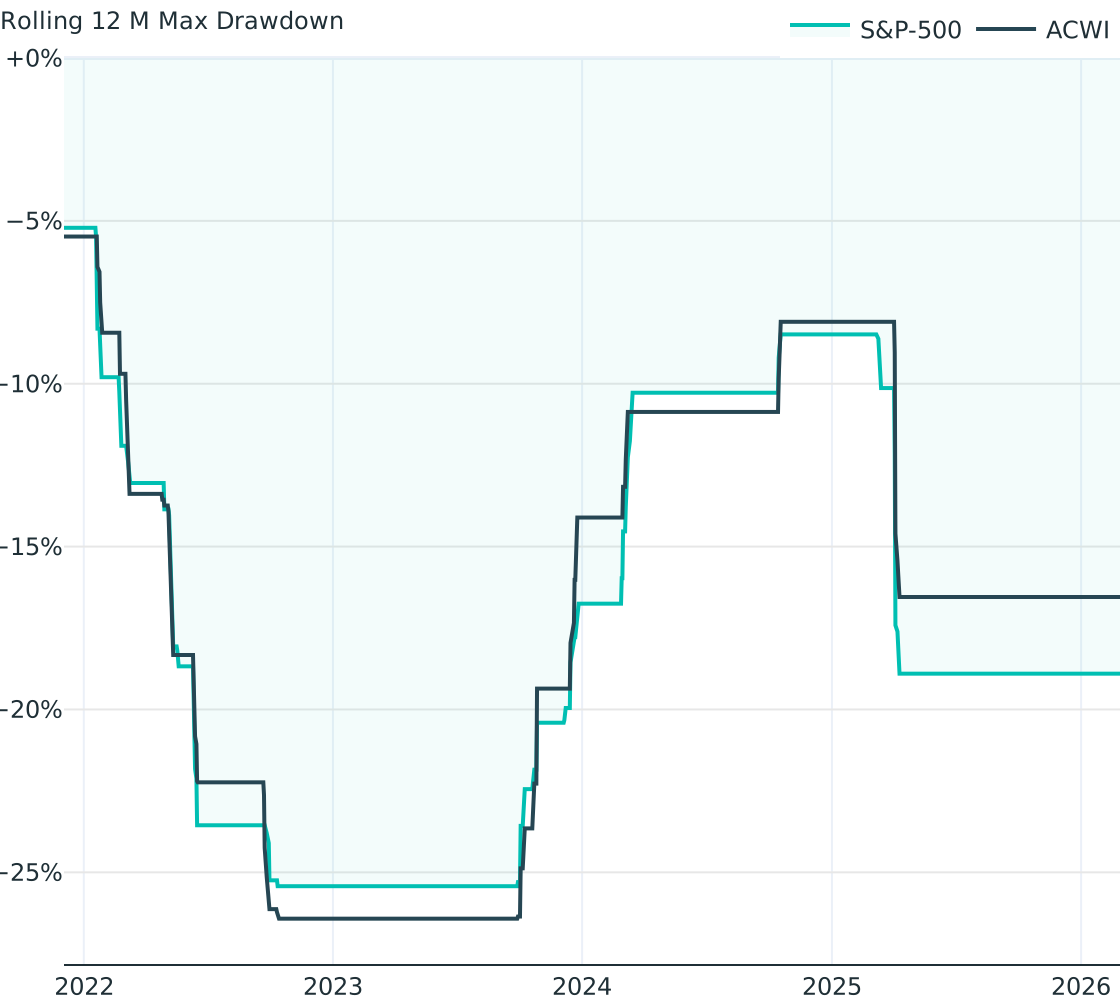
Rolling 12 M max drawdown: S&P-500 vs. ACWI
This view is useful for understanding how drawdown risk has varied through different market regimes. A period of low rolling maximum drawdown suggests the portfolio was in a benign environment; a spike in rolling maximum drawdown marks a period of elevated loss risk. It also provides a realistic sense of the range of drawdown outcomes an investor might expect depending on when they invested.
Rolling maximum drawdown is available in pfolio Insights and the pfolio app alongside the full-period scalar figure.
Limitations
Maximum drawdown is backward-looking. The worst historical drawdown does not bound future drawdowns—an investment may experience a more severe decline in the future than anything in its recorded history. This is particularly relevant for assets with short track records, where the historical maximum may not have captured a full market cycle.
Maximum drawdown captures the depth of the worst decline but says nothing about how long recovery took. A 30% drawdown recovered in six months is a very different experience from a 30% drawdown that took four years to recover. Drawdown duration and recovery time are important dimensions of risk that the single MDD figure does not capture.
Like all price-based metrics, maximum drawdown depends on the length of the history available. A longer price history is more likely to include a severe bear market, which will compress the maximum drawdown figure. Comparing maximum drawdowns across assets with materially different history lengths requires care.
Maximum drawdown in pfolio
In pfolio, maximum drawdown is calculated on time series price data. By default this uses the close price; switching to adjusted close—which accounts for dividends and splits—can be configured via advanced settings. The choice of price series affects the result, particularly for dividend-paying assets over long periods. See time series data and metric types for a full explanation.
Maximum drawdown and rolling maximum drawdown are both available in pfolio Insights. For a full description of how pfolio calculates this and all other metrics, see the metrics we use.
Related metrics
Disclaimer

Get started now


