



Correlation in portfolio management: why diversification depends on it
Adding more assets to a portfolio does not automatically reduce risk. What matters is how those assets move relative to each other. Correlation measures this relationship: it ranges from −1 (assets move in perfect opposition) to +1 (assets move in lockstep). Combining assets with low or negative correlation is how diversification actually reduces portfolio volatility—which is why understanding correlation is fundamental to understanding how portfolios are constructed and when diversification fails.
What correlation measures
The role of correlation as the mechanism through which diversification reduces portfolio risk was formalised by Harry Markowitz (1952) in Portfolio Selection, Journal of Finance. Markowitz demonstrated mathematically that combining assets with less-than-perfect positive correlation reduces portfolio variance beyond what is achievable by holding any individual asset—the quantitative foundation of modern diversification theory.
Correlation quantifies the linear relationship between the return series of two assets. It takes values between −1 and +1. A correlation of +1 means the two assets move perfectly in step—when one rises by 1%, the other rises by the same proportion. A correlation of −1 means they move in perfect opposition. A correlation of zero indicates no linear relationship between the two return series.
In portfolio construction, correlation is the mechanism through which diversification actually works. A portfolio of two assets with a correlation of +1 behaves like holding a single asset—the returns simply average out, and volatility is unchanged. Combine two assets with a correlation of −0.5, however, and the portfolio's volatility falls materially below the weighted average of the two individual volatilities. The lower the correlation between assets, the greater the diversification benefit.
Lower correlation is generally preferable from a portfolio construction perspective, though the appropriate benchmark depends on the purpose. When evaluating a potential addition to an existing portfolio, the relevant question is not the asset's standalone volatility—it is how it correlates with what is already held. An asset with modest standalone returns but low correlation with the rest of the portfolio may add more value than a higher-returning asset that moves in line with the existing holdings.
pfolio calculates correlation against a configurable benchmark. The benchmark used affects the result, and the figure should always be read in that context.
The formula
ρ = Cov(r, rB) / (σ · σB)
Where:
- ρ = correlation coefficient
- r = asset return series
- rB = benchmark return series
- σ = standard deviation of asset returns
- σB = standard deviation of benchmark returns
The formula divides the covariance of the two return series by the product of their standard deviations. This normalises covariance—which is sensitive to the scale of the input series—into the dimensionless range of −1 to +1. The result is a figure that reflects the direction and strength of the co-movement, independent of either asset's individual volatility.
How to interpret correlation
The sign and magnitude of the correlation coefficient each carry meaning. A positive correlation means the two series tend to move in the same direction; a negative correlation means they tend to move in opposite directions. The closer the value is to +1 or −1, the stronger the relationship; values near zero suggest the two series move largely independently.
As a practical example: an equity ETF tracking a broad global stock index and a government bond fund might show a correlation of −0.20 over a long sample period. This negative correlation—even if modest—means the two assets have historically moved in opposite directions often enough to provide meaningful portfolio stabilisation. Adding bonds to an equity portfolio has historically reduced overall portfolio volatility even when bonds themselves are not high-returning assets. Compare this to two equity ETFs tracking different regional markets: they might show a correlation of +0.85. Holding both reduces concentration in any single region, but provides limited diversification benefit at the portfolio level because the underlying assets respond to similar global risk factors.
Common misinterpretation: a low correlation between two assets does not mean they cannot both fall simultaneously. Correlation captures the average linear relationship over the measurement period. In sharp market dislocations, previously uncorrelated assets often fall together. This is the behaviour known as correlation breakdown, and it is one of the most significant limitations of using historical correlation in portfolio construction.
Rolling correlation
A single scalar correlation figure summarises the entire measurement period. This is useful as a headline statistic but it flattens a relationship that may have shifted substantially over time. Rolling correlation computes the same metric repeatedly over a sliding window—for example, computing the correlation for every trailing 12-month period—and produces a time series of how the relationship has evolved.
Rolling correlation is particularly valuable for detecting regime changes. Two assets that show low correlation over a ten-year sample may reveal, on closer inspection, that they were uncorrelated for eight years and then highly correlated for two years following a market disruption. The scalar figure would suggest moderate correlation throughout; the rolling chart shows what actually happened.
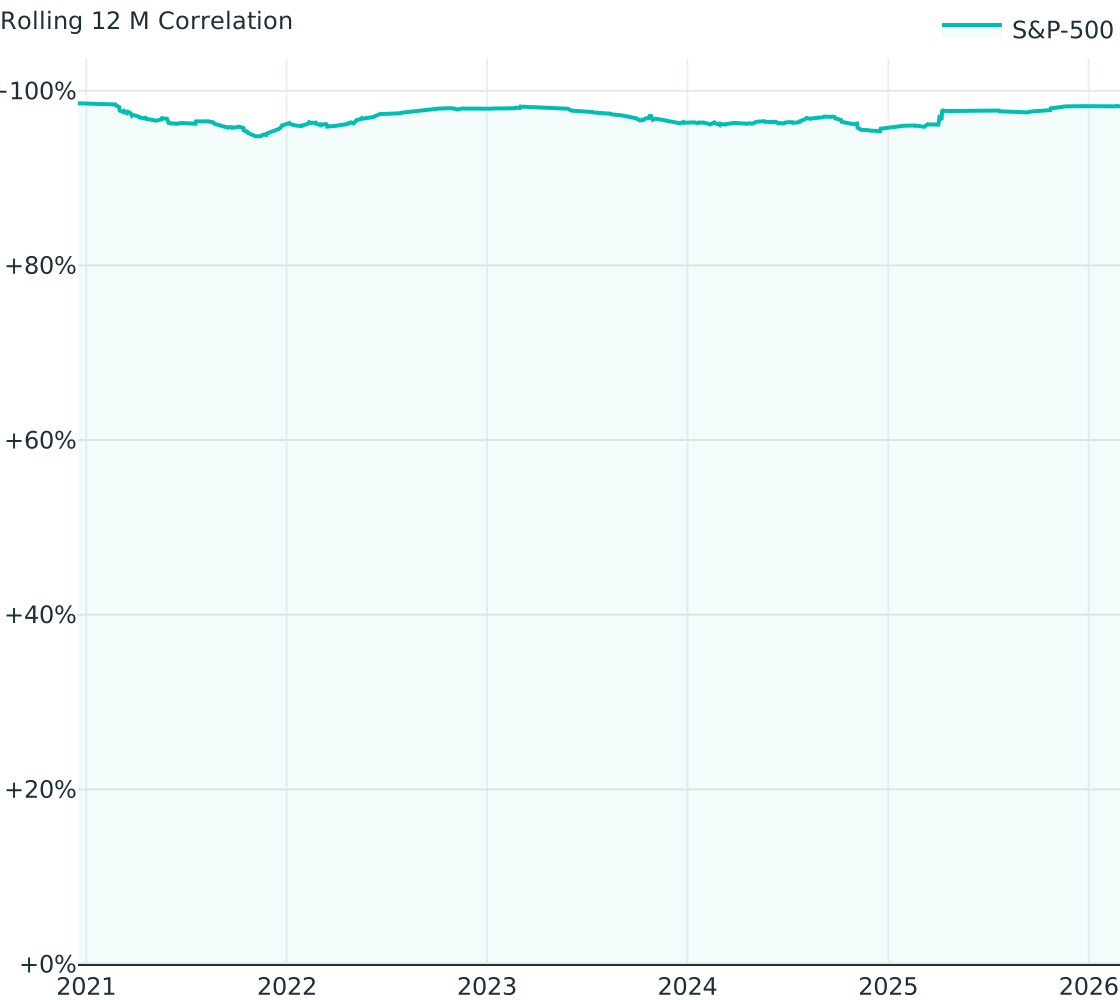
Rolling 12 M correlation: S&P-500 vs. ACWI
The window length is configurable. A shorter lookback period captures recent co-movement with greater sensitivity but is noisier; a longer window smooths out short-term fluctuations and gives a more stable estimate of the structural relationship. For portfolio construction purposes, understanding the stability of correlation across different windows is often as informative as the correlation itself.
Rolling correlation is available in pfolio Insights, as well as the pfolio app, alongside the scalar figure.
Limitations
Correlation measures only linear relationships. Two assets can have a complex non-linear dependency—both falling sharply in a crisis while moving independently in normal conditions—and still show a near-zero correlation coefficient over a long sample. The correlation figure would suggest diversification; the actual portfolio behaviour in a downturn would not deliver it.
The most significant practical limitation of historical correlation is its instability under stress. Correlations across asset classes tend to converge toward +1 in market crises—equities, high-yield credit, commodities, and emerging market assets that appeared largely uncorrelated during calm periods often fall together when liquidity dries up and forced selling dominates. This is sometimes called correlation breakdown. A portfolio constructed on the assumption that historical correlations will persist is most likely to encounter its shortfall precisely when diversification matters most.
Correlation is also sensitive to the measurement period. The same pair of assets can show materially different correlation values depending on the start and end dates of the sample. A measurement period that includes a prolonged equity bull market will not reflect how those assets co-move in a downturn. For this reason, correlation estimates should be interpreted alongside their historical context, not as stable parameters.
Finally, correlation depends on the benchmark chosen. The correlation of a global equity ETF against a government bond index is a different figure from its correlation against a commodity index or a cryptocurrency. The result should always be read with reference to the specific benchmark used.
Correlation in pfolio
In pfolio, correlation is calculated from the return series derived from the price data. Whether those returns are computed from the close price or the adjusted close price can be configured via advanced settings—a distinction that matters for dividend-paying assets. The benchmark against which correlation is calculated is configurable. Correlation is displayed alongside rolling correlation in pfolio Insights, as well as the pfolio app. For a full description of how pfolio calculates this and all other metrics, see the metrics we use.
Related metrics
Disclaimer

Get started now


