



Portfolio beta: understanding market sensitivity and systematic risk
Beta measures how much a portfolio or asset moves in response to movements in a benchmark. It quantifies the sensitivity of returns to a reference market—the foundational measure of systematic risk in modern portfolio theory.
What beta measures
Beta was formalised as part of the Capital Asset Pricing Model by William Sharpe (1964) in Capital Asset Prices: A Theory of Market Equilibrium under Conditions of Risk, Journal of Finance, building on Markowitz’s (1952) portfolio theory. The CAPM decomposed total risk into market-driven systematic risk—represented by beta—and firm-specific risk that diversification can eliminate. Beta remains the standard measure of an asset’s sensitivity to market-wide movements.
Beta expresses the relationship between an asset’s returns and those of a chosen benchmark. A beta of 1.0 means the asset moves in line with the benchmark: when the benchmark rises 10%, the asset is expected to rise 10%; when it falls, the asset is expected to fall by a similar amount. A beta above 1.0 indicates the asset amplifies benchmark movements; a beta below 1.0 indicates it dampens them; a negative beta indicates the asset tends to move in the opposite direction.
The metric takes two return series as its inputs—the asset or portfolio returns and the benchmark returns—and produces a single coefficient. In pfolio, beta is a ‘lower is better’ metric, reflecting the perspective that lower sensitivity to market movements generally implies lower systematic risk. A beta close to zero or negative means the portfolio is largely insulated from benchmark fluctuations, which is valuable in bear markets.
Beta only measures the linear relationship to one specific benchmark. The result depends entirely on which benchmark is chosen, and this dependency must be kept in mind whenever beta figures are compared across sources or used to make allocation decisions.
The formula
β = Cov(r, rB) / Var(rB)
Where:
- β = beta
- r = asset returns
- rB = benchmark returns
- Cov(r, rB) = covariance of asset and benchmark returns
- Var(rB) = variance of benchmark returns
The formula divides the covariance of the asset and benchmark returns by the variance of the benchmark. This normalises the relationship: if the asset and benchmark moved identically, the covariance would equal the benchmark variance and beta would be 1.0.
How to interpret beta
Beta is most useful in the context of how much systematic (market) risk a portfolio carries relative to a reference index. A globally diversified equity fund tracking the MSCI World will have a beta close to 1.0 against that index by construction. An absolute-return or multi-asset strategy designed to limit market exposure might target a beta below 0.5 or even negative.
A concrete example: a portfolio with a beta of 0.60 against a global equity benchmark would be expected to rise approximately 6% when the benchmark rises 10%, and fall approximately 6% when the benchmark falls 10%. The portfolio is less volatile than the benchmark on a market-correlated basis, though it may still have meaningful absolute risk from non-correlated asset classes.
Beta should not be confused with total risk. A portfolio with a low beta against equities might still have high volatility from, say, concentrated commodity or cryptocurrency exposure. Beta measures one specific relationship; it does not summarise overall risk.
Rolling beta
The scalar beta summarises the sensitivity of the full return history to the chosen benchmark. Rolling beta computes the same metric over a sliding window, showing how market sensitivity has evolved through time.
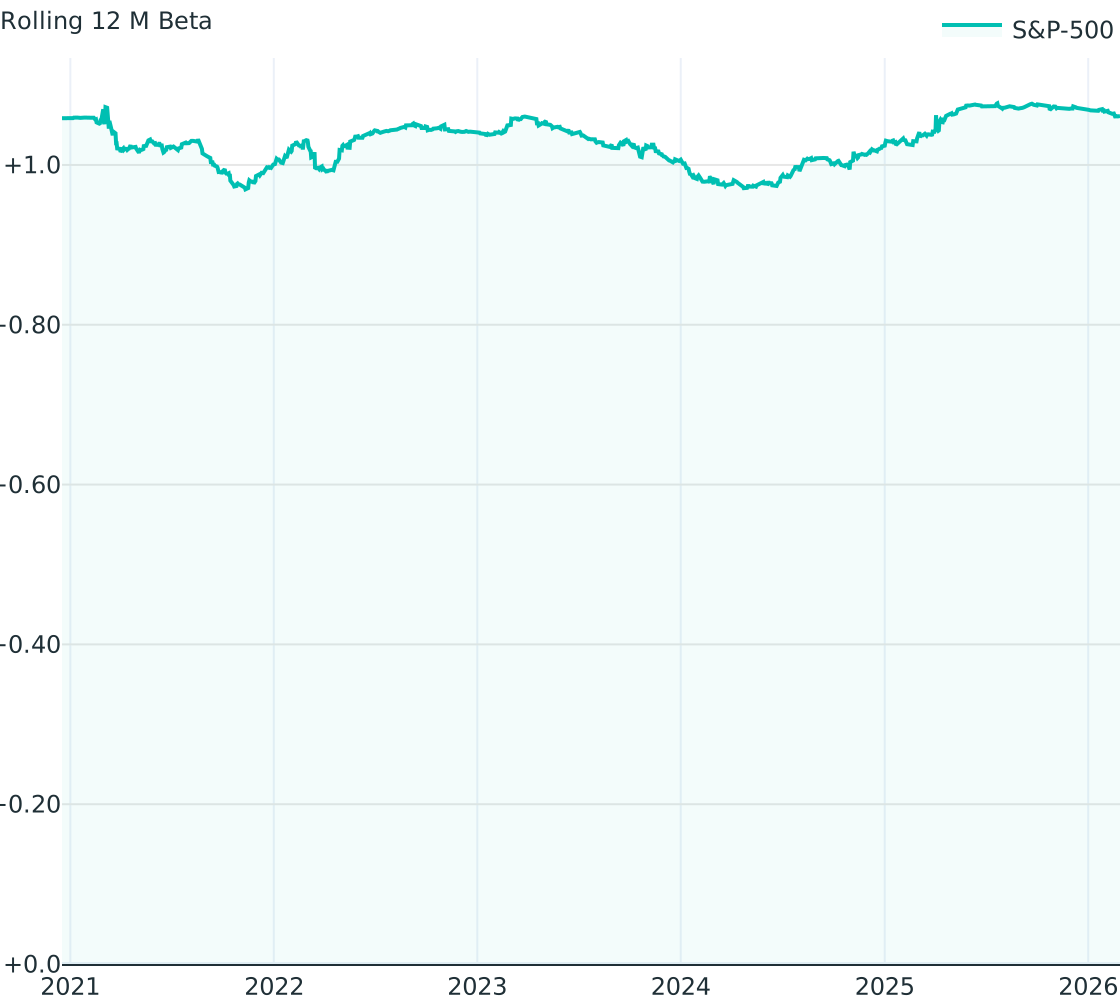
Rolling 12 M beta: S&P-500 vs. ACWI
This view is particularly valuable for multi-asset and adaptive strategies, where the relationship to equity benchmarks can change materially depending on market conditions. A rolling beta chart that shows systematically low beta during equity drawdowns and higher beta during rallies would indicate a strategy that successfully reduces market exposure when it matters most.
Rolling beta is available in the pfolio app. The benchmark used in pfolio is configurable, allowing beta to be measured against the market index most relevant to a given portfolio’s objective.
Limitations
Beta measures a linear relationship to one benchmark only. Non-linear exposures and dependencies on multiple factors are not captured. A portfolio that is systematically short volatility, for instance, may show a low beta to an equity index in normal conditions but experience large losses precisely when equities sell off sharply—a relationship that linear beta would not reveal.
Beta is also highly sensitive to the choice of benchmark. The same portfolio can show very different beta values against a broad global equity index, a regional equity index, a bond index, or a balanced multi-asset index. Beta without a stated benchmark is not interpretable. When reviewing beta in pfolio or anywhere else, always note which benchmark was used.
Finally, beta is not stable over time. The sensitivity of a multi-asset portfolio to an equity benchmark typically varies with market regime: correlations tend to rise in crises, which can cause beta to spike precisely when low market exposure would be most valuable. The rolling beta view addresses this directly.
Beta in pfolio
In pfolio, beta is calculated from the return series derived from the price data. Whether those returns are computed from the close price or the adjusted close price can be configured via advanced settings—a distinction that matters for dividend-paying assets. The benchmark is configurable in pfolio and affects the result directly.
Beta and rolling beta are available in the pfolio app. For a full description of how pfolio calculates this and all other metrics, see the metrics we use.
Related metrics
Disclaimer

Get started now


