



Downside volatility: the risk measure that focuses on what actually hurts
Downside volatility is a refinement of standard volatility that counts only negative return periods in its calculation. Where standard volatility treats a large positive return the same as a large negative one, downside volatility focuses exclusively on the downside—the fluctuations that represent actual losses. For investors who are more concerned with protecting against losses than with upside variation, it is a more relevant measure of risk.
What downside volatility measures
The case for measuring only downside risk—rather than total variability—was made by A.D. Roy (1952) in Safety First and the Holding of Assets, Econometrica, which argued that investors care about avoiding losses below a minimum threshold, not about gains. The formal downside volatility measure was developed further by Frank Sortino and Lyle Price (1994) in Performance Measurement in a Downside Risk Framework, Journal of Investing, and is the denominator of the Sortino ratio.
Standard volatility measures dispersion in both directions: it penalises a month of +20% returns just as it penalises a month of −20% returns, because both deviate equally from the mean. Most investors do not experience a large positive return as a form of risk. Downside volatility addresses this by using only returns that fall below a threshold—typically zero, meaning only periods of negative returns contribute to the calculation.
The result is a measure that focuses entirely on the distribution of losses. A portfolio that delivers high but volatile positive returns alongside modest losses would show high standard volatility but lower downside volatility—correctly reflecting that the risk experienced by the investor is primarily on the upside, not the downside.
In pfolio, downside volatility is a ‘lower is better’ metric. Lower downside volatility means the portfolio’s loss periods are smaller and less severe. It is the denominator of the Sortino ratio, which uses it to compute a downside-focused measure of risk-adjusted return.
The formula
σᵈ = √(T/n × Σ min(rᵢ, 0)²)
Where:
- σᵈ = annualised downside volatility
- T = number of periods per year (252 for daily data, 12 for monthly)
- n = total number of observations in the return series (all periods, including positive ones)
- rᵢ = return for period i
The formula applies the standard deviation calculation only to negative returns. For each period, if the return is negative, its squared value is included; if positive, it contributes zero. The sum of squared negative returns is divided by the total number of observations (not just the negative ones), then multiplied by T and square-rooted to annualise.
This use of the total observation count in the denominator—rather than just the count of negative periods—means that downside volatility is always lower than or equal to standard volatility. A portfolio with few loss periods will show a very low downside volatility even if those individual losses are significant.
How to interpret downside volatility
Downside volatility is interpreted similarly to standard volatility but with a narrower focus. A downside volatility of 8% means that negative return periods, when considered over the full series, are equivalent to an annualised standard deviation of 8% on the downside only.
The most useful comparison is between an asset’s standard volatility and its downside volatility. If the two are close in value, losses and gains are roughly equally distributed—the standard volatility is an accurate picture of overall risk. If downside volatility is substantially lower than standard volatility, the asset’s positive periods are driving most of the dispersion, and the investor’s actual loss experience is more modest than the standard deviation would suggest.
As a worked example: a portfolio might show annualised volatility of 14% and annualised downside volatility of 9%. The gap reflects that a significant portion of the volatility comes from large positive months. An investor primarily concerned with capital preservation would find the 9% figure more informative than the 14%.
Rolling downside volatility
The scalar downside volatility figure summarises the full measurement period. Rolling downside volatility computes the same metric over a sliding window, showing how the severity of negative return periods has evolved over time.
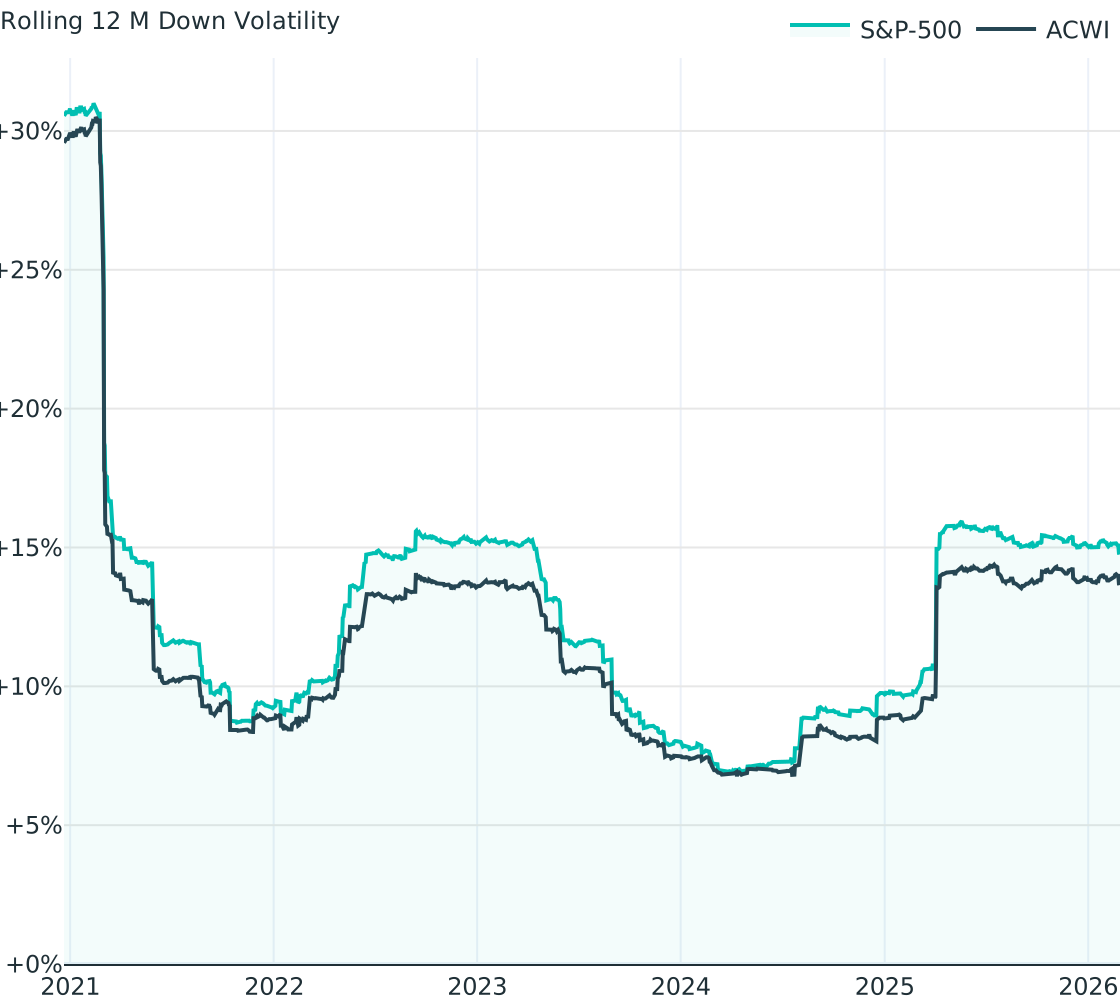
Rolling 12 M downside volatility: S&P-500 vs. ACWI
This view can reveal whether loss periods tend to cluster—for example, spiking during market downturns and falling during calm periods. A portfolio that shows consistently low rolling downside volatility across different market regimes is demonstrating stable loss management; one that shows large spikes during stress periods may be exposing investors to concentrated downside risk even if its headline volatility appears reasonable.
Rolling downside volatility is available in the pfolio app.
Limitations
The threshold used to define ‘downside’ matters. pfolio uses zero as the threshold: only negative returns contribute to the calculation. Some implementations use the mean return as the threshold instead, which would include any period returning less than average—even if it was still positive. These two approaches produce different figures, and the distinction should be noted when comparing results across different sources.
Because only negative returns are included, downside volatility is estimated from a smaller subset of the data than standard volatility. For portfolios with few loss periods or short return histories, the estimate can be noisy and sensitive to individual observations.
Downside volatility also says nothing about the worst individual loss—only the typical severity of negative periods. For the worst-case loss measure, maximum drawdown is more appropriate.
Downside volatility in pfolio
In pfolio, downside volatility is calculated from the return series derived from the price data. Whether those returns are computed from the close price or the adjusted close price can be configured via advanced settings—a distinction that matters for dividend-paying assets. pfolio uses zero as the threshold for defining downside returns.
Downside volatility and rolling downside volatility are available in the pfolio app. For a full description of how pfolio calculates this and all other metrics, see the metrics we use.
Related metrics
Disclaimer

Get started now


