


Kurtosis in finance: understanding fat tails and extreme return risk
Kurtosis in finance measures the shape of a return distribution's tails—specifically, how much probability mass sits in the extremes relative to a normal distribution. A high kurtosis indicates that extreme returns, both large gains and large losses, occur more frequently than a normal distribution would predict. In investment risk management, this property is sometimes called fat tails or leptokurtosis, and it has material implications for how risk is measured and managed.
What kurtosis measures
Excess kurtosis in financial returns was documented empirically by Benoît Mandelbrot (1963) in The Variation of Certain Speculative Prices, Journal of Business, and confirmed for equity returns by Fama (1965) in The Behavior of Stock-Market Prices, Journal of Business. Both papers demonstrated that observed financial return distributions have heavier tails than a normal distribution predicts—an empirical finding now replicated across virtually every liquid asset class and time period.
Any distribution of returns can be described by a set of statistical moments. The first moment is the mean—the average return. The second moment is variance—how dispersed returns are around the mean. The third moment is skewness—whether the distribution is asymmetric. The fourth moment is kurtosis, which captures the behaviour of the distribution's tails relative to its centre.
A normal distribution has a kurtosis of three. In practice, it is common to report excess kurtosis, which subtracts three from the raw figure so that a normal distribution has an excess kurtosis of zero. A positive excess kurtosis—also called leptokurtosis—indicates heavier tails than a normal distribution: extreme outcomes occur more often than a Gaussian model would suggest. A negative excess kurtosis—platykurtosis—indicates lighter tails and a flatter peak.
Financial returns consistently exhibit positive excess kurtosis. This is one of the most well-documented empirical findings in quantitative finance. It means that models built on the assumption of normally distributed returns—including standard mean-variance optimisation and many risk models—will underestimate the frequency and severity of extreme outcomes.
How kurtosis is calculated
The formula for excess kurtosis is:
Excess kurtosis = [Σ(rᵢ − r̄)⁴ / n] / σ⁴ − 3
Where rᵢ is each return observation, r̄ is the mean return, σ is the standard deviation, and n is the number of observations. The fourth power means that large deviations from the mean are amplified disproportionately—a return four times the standard deviation contributes 256 times more to the kurtosis calculation than a return equal to the standard deviation. This is precisely why kurtosis captures the behaviour of the tails rather than the centre of the distribution.
Kurtosis and volatility
Kurtosis and volatility measure different aspects of return distributions. Volatility, expressed as standard deviation, measures the average dispersion of returns around the mean. Kurtosis measures whether extreme outcomes occur more frequently than volatility alone would suggest.
Two portfolios can have identical volatility but different kurtosis. The portfolio with higher kurtosis will experience more frequent and more severe tail events—large positive or large negative returns—even though its average dispersion is the same. Using volatility as the sole measure of risk can therefore significantly understate exposure in high-kurtosis portfolios.
Kurtosis and skewness
Kurtosis is often discussed alongside skewness, the third moment of a return distribution. Skewness measures asymmetry—whether returns are skewed toward large gains or large losses. Kurtosis measures tail weight regardless of direction.
In practice, the two frequently interact. Equity markets during stress periods tend to exhibit both negative skewness—losses are more extreme than gains—and high kurtosis—extreme outcomes occur more frequently than normal. A risk framework that captures only skewness or only kurtosis gives an incomplete picture of tail behaviour.
Rolling kurtosis
The scalar kurtosis figure summarises the tail behaviour of the full return history as a single number. Rolling kurtosis computes the same metric over a sliding window, showing how the thickness of the distribution's tails has evolved through time. Each point answers the question: what was the excess kurtosis over the return series ending on this date?
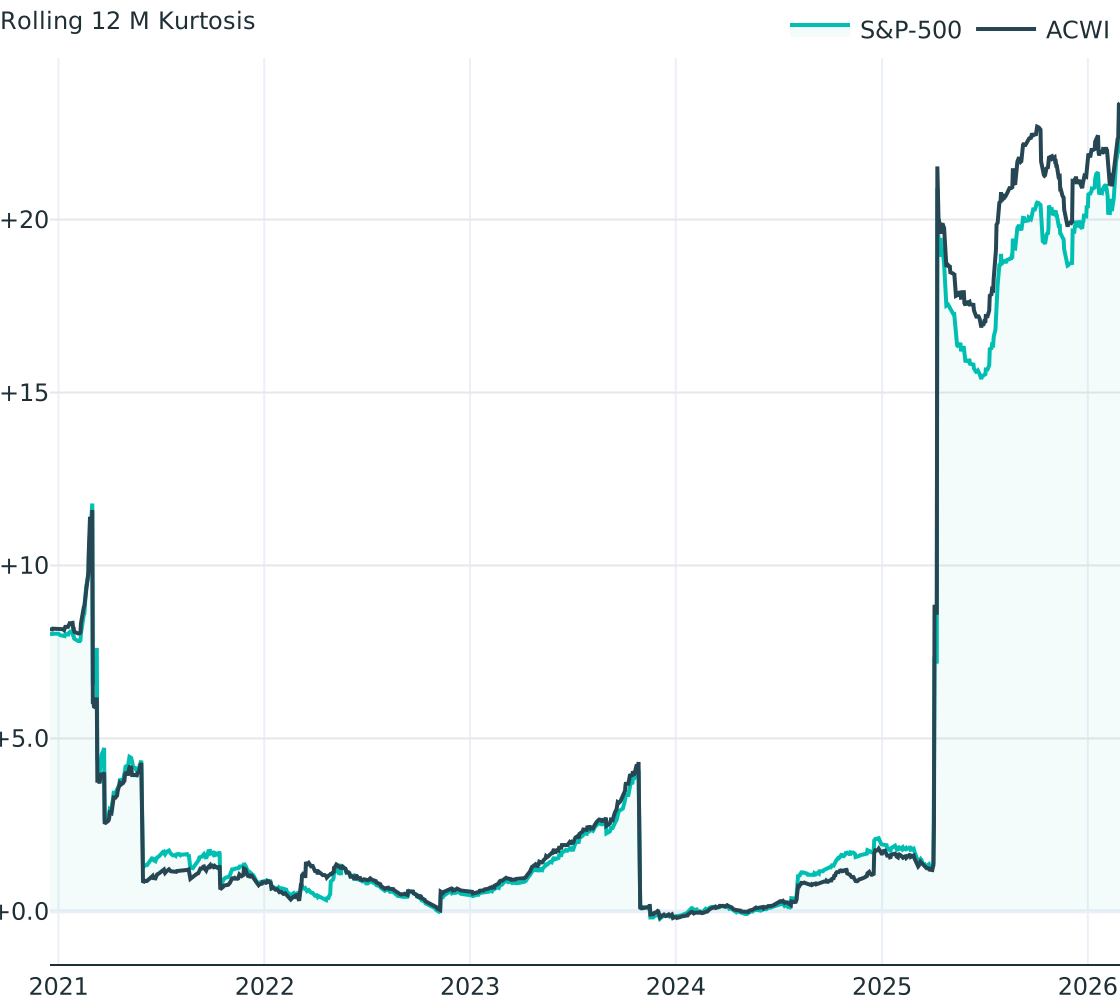
Rolling 12 M kurtosis: S&P-500 vs. ACWI
This view is useful for detecting regime changes in tail behaviour. An asset that appears to have moderate kurtosis over a long sample may reveal, on closer inspection, periods of elevated kurtosis that coincide with market stress events—when extreme returns cluster. The scalar figure smooths over this variation; the rolling chart makes it directly visible, allowing investors to assess whether fat-tail risk is a persistent feature of an asset or concentrated in specific market episodes.
Rolling kurtosis is available in the pfolio app.
Kurtosis in pfolio
In pfolio, kurtosis is reported as excess kurtosis—the raw fourth-moment value minus three, so that a normal distribution scores zero. Whether returns are computed from close price or adjusted close price can be configured via advanced settings. Rolling kurtosis is available in the pfolio app, showing how tail behaviour has varied across different market regimes. For a full description of how pfolio calculates this and all other metrics, see the metrics we use.
Practical implications for portfolio management
High kurtosis in a portfolio's return distribution indicates that standard risk metrics such as volatility and value at risk will underestimate the probability of extreme losses. A VaR estimate derived from a normal distribution assumption will be too low for an asset or portfolio exhibiting leptokurtosis.
This has implications for position sizing, drawdown expectations, and stress testing. Risk models that explicitly account for fat tails—such as those using expected shortfall rather than VaR—provide more realistic estimates of tail exposure in the presence of high kurtosis.
Multi-asset diversification, which is central to pfolio's portfolio construction methodology, reduces the impact of high kurtosis in any single asset class. When asset classes are imperfectly correlated, extreme returns in one are less likely to coincide with extreme returns in others, reducing portfolio-level tail risk.
Related metrics
Disclaimer

Get started now


