



Expected shortfall (CVaR): a more complete measure of tail risk than VaR
Value at risk tells you where your portfolio's worst-case losses begin—at a given confidence level, it marks the threshold. But it says nothing about how severe losses become once you cross it. Expected shortfall—also known as conditional value at risk (CVaR)—answers that question: it measures the average loss in the worst x% of outcomes, capturing not just where the tail starts but the depth of what lies inside it.
What expected shortfall measures
The theoretical case for expected shortfall over VaR was established by Artzner, Delbaen, Eber, and Heath (1999) in Coherent Measures of Risk, Mathematical Finance. Their analysis showed that VaR fails the sub-additivity property—a diversified portfolio can show higher VaR than the sum of its components—making it an inconsistent measure for portfolio construction. Expected shortfall satisfies sub-additivity and was adopted by the Basel Committee under the Fundamental Review of the Trading Book (2019) to replace VaR for regulatory market risk capital.
Expected shortfall takes the question that VaR leaves unanswered: given that we are already in the tail of the return distribution—in the worst x% of outcomes—what is the average loss we should expect? The result is a conditional mean: not the threshold, but the expected value of losses beyond it.
At a 95% confidence level, expected shortfall gives the average return in the worst 5% of periods. If a portfolio's 95% daily VaR is −2%, its expected shortfall at the same level will be more negative than −2%—it reflects the mean of all those worst 5% days, which by definition are worse than the VaR threshold.
Expected shortfall is also a 'higher is better' metric in pfolio, where 'higher' means closer to zero. Because it captures the depth of the tail rather than merely its starting point, expected shortfall is a more conservative and more informative risk measure than VaR for investors concerned with severe loss scenarios.
The formula
ESα = E[r | r < VaRα]
Where:
- ESα = expected shortfall at confidence level α
- r = portfolio return
- VaRα = value at risk at confidence level α
The formula reads: the expected value of the return r, conditional on r being worse than the VaR threshold. Under the parametric (normal distribution) assumption used in pfolio, this can be computed analytically from the mean return, volatility, and the relevant normal distribution density function.
How to interpret expected shortfall
Expected shortfall is always more negative than VaR at the same confidence level—it represents the average of the worst outcomes rather than the least bad among them. The gap between ES and VaR indicates how heavy-tailed the return distribution is: a small gap suggests losses in the tail are relatively clustered near the threshold; a large gap suggests some very extreme observations are pulling the average down.
As a concrete example: if a portfolio has a 95% annual VaR of −15%, its expected shortfall might be −22%. This means that in the worst 5% of annual outcomes, the average loss is 22%—not merely 15%.
Expected shortfall is widely used in risk management and increasingly in regulatory frameworks (Basel III shifted from VaR to expected shortfall as the primary market risk measure). For portfolio evaluation, it provides a more complete picture of tail risk than VaR alone and is especially valuable for portfolios that include assets with skewed or fat-tailed return distributions.
Rolling expected shortfall
The scalar expected shortfall summarises tail risk across the full return history. Rolling expected shortfall computes the same metric over a sliding window, showing how average tail losses have evolved through time. Each point answers the question: what was the expected shortfall over the return series ending on this date?
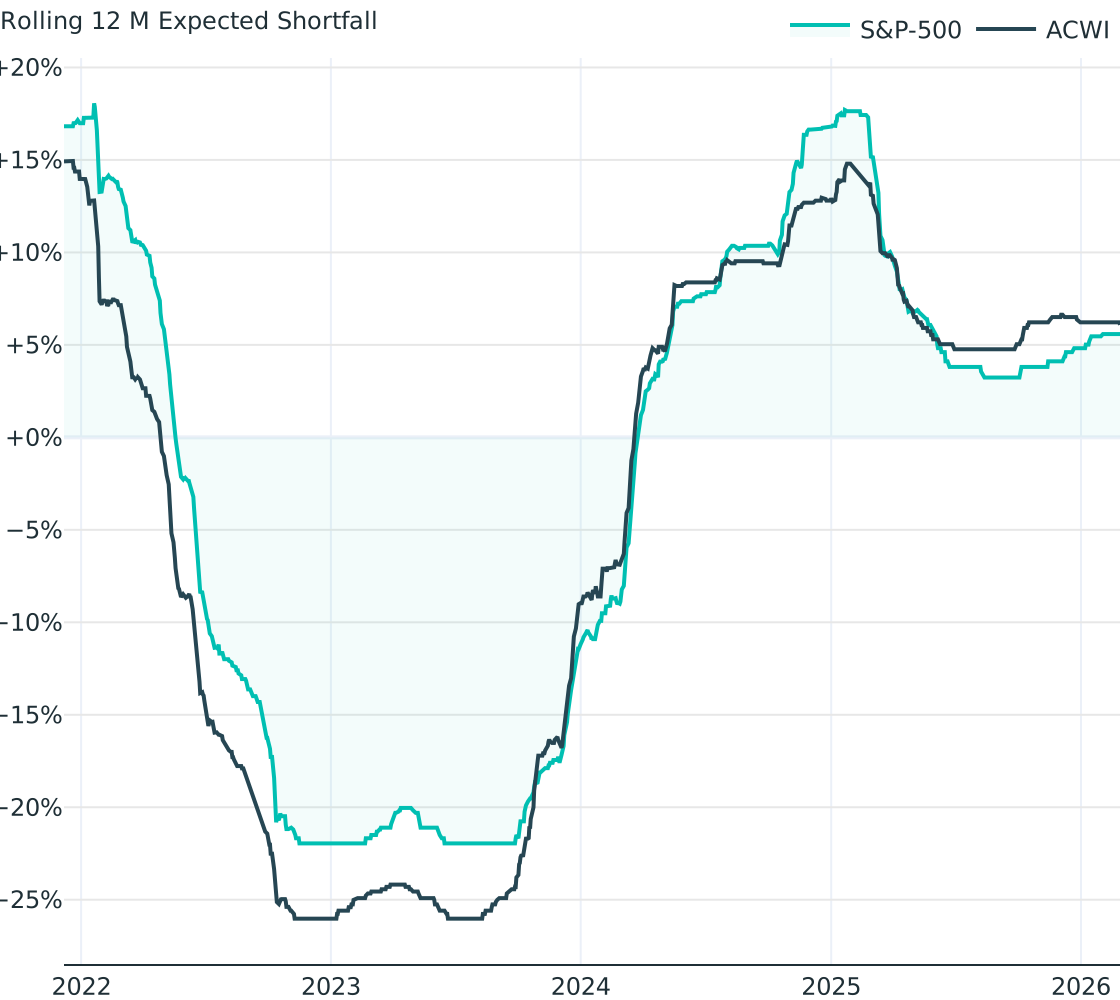
Rolling 12 M expected shortfall: S&P-500 vs. ACWI
During periods of market stress, rolling expected shortfall tends to deteriorate sharply as extreme returns cluster. Watching rolling ES alongside rolling VaR reveals whether elevated tail risk is primarily a matter of more frequent exceedances (captured by VaR) or increasingly severe losses when exceedances occur (captured by the gap between ES and VaR).
Rolling expected shortfall is available in the pfolio app.
Limitations
Expected shortfall inherits the main limitation of VaR: pfolio uses the parametric (Gaussian) method, which assumes normally distributed returns. For assets with fat tails or significant skewness—equities, commodities, cryptocurrencies—the normal distribution underestimates how extreme the worst observations can be. Parametric expected shortfall will therefore systematically understate the average severity of tail losses for such assets.
Expected shortfall is also more sensitive to outliers than VaR. A single extreme return observation—particularly relevant for illiquid or volatile assets—can pull the conditional average significantly and may not reflect typical tail behaviour. Short return histories amplify this sensitivity: a handful of extreme days can dominate the calculation.
Finally, like VaR, expected shortfall depends on the confidence level chosen. The 95% ES and 99% ES for the same portfolio tell different stories about the depth of the tail, and comparison across sources requires consistent confidence level conventions.
Expected shortfall in pfolio
In pfolio, expected shortfall is calculated from the return series derived from the price data. Whether those returns are computed from the close price or the adjusted close price can be configured via advanced settings—a distinction that matters for dividend-paying assets.
Expected shortfall and rolling expected shortfall are available in the pfolio app. pfolio uses the parametric method at a default confidence level of 95%. For a full description of how pfolio calculates this and all other metrics, see the metrics we use.
Related metrics
Disclaimer

Get started now


