



Alpha in investing: what it means and how systematic strategies generate it
Alpha measures the return a portfolio generates above what would be expected given its exposure to a benchmark. It is the standard metric for evaluating whether active management—or any systematic strategy—is adding value beyond what a passive benchmark exposure alone would have delivered.
What alpha measures
Alpha as a measure of benchmark-adjusted portfolio performance was formalised by Michael Jensen (1968) in The Performance of Mutual Funds in the Period 1945–1964, Journal of Finance. Jensen showed that on average, actively managed mutual funds failed to generate positive alpha net of costs—one of the earliest large-sample tests of market efficiency using a risk-adjusted return framework. The metric has since become the standard for evaluating whether any investment strategy—active, systematic, or otherwise—generates returns beyond what benchmark exposure alone would predict.
Alpha is the residual return after accounting for benchmark-driven performance. If a portfolio returned 12% in a year and its benchmark returned 10%, a naive calculation might credit the manager with 2% of outperformance. But if the portfolio had a beta of 1.4 to the benchmark—meaning it amplified benchmark movements by 40%—that 12% return would actually be below what the portfolio’s market exposure alone would predict. Alpha adjusts for this: it is the return beyond what beta-driven exposure explains.
The metric takes two return series as inputs—the asset or portfolio returns and the benchmark returns—plus the risk-free rate, and produces a single figure. Positive alpha indicates the portfolio has generated returns above what its market exposure alone would predict. Negative alpha indicates underperformance relative to that benchmark-adjusted expectation. In pfolio, higher alpha is preferable.
Alpha is always benchmark-relative. This is its most important characteristic and its central limitation. A strategy that generates significant positive alpha against one benchmark may show negative or zero alpha against a different, more appropriate one. Alpha without a stated benchmark is not interpretable.
The formula
α = μ̅ − rf − β (μ̅B − rf)
Where:
- α = alpha
- μ̅ = asset annualised mean return
- rf = risk-free rate
- β = beta (sensitivity to the benchmark)
- μ̅B = benchmark annualised mean return
The formula subtracts from the asset’s mean return both the risk-free rate and the component of return attributable to benchmark exposure (beta multiplied by the benchmark’s excess return). What remains is alpha: the return unexplained by the risk-free rate and by market sensitivity.
How to interpret alpha
An alpha of zero means the portfolio performed exactly in line with what its benchmark exposure predicted: no more, no less. Positive alpha means the strategy added value on a risk-adjusted basis; negative alpha means it subtracted value.
A worked example: a portfolio has an annualised mean return of 11%, a beta of 0.8 to a benchmark that returned 10%, and a risk-free rate of 2%. The benchmark excess return is 8%. The expected return given beta is 2% + 0.8 × 8% = 8.4%. The alpha is 11% − 8.4% = 2.6%. The strategy added approximately 2.6% per year beyond what benchmark exposure alone would explain.
For systematic strategies like those in pfolio, alpha represents the contribution of the methodology—momentum filtering, optimised asset allocation, adaptive rebalancing—beyond passive benchmark exposure. This is meaningful, but it should always be assessed over a long and complete market cycle, not a cherry-picked period.
Rolling alpha
The scalar alpha summarises benchmark-adjusted outperformance over the full measurement period. Rolling alpha computes the same metric over a sliding window, showing how value-added relative to the benchmark has varied through different market environments. Each point answers the question: what was the alpha over the period ending on this date?
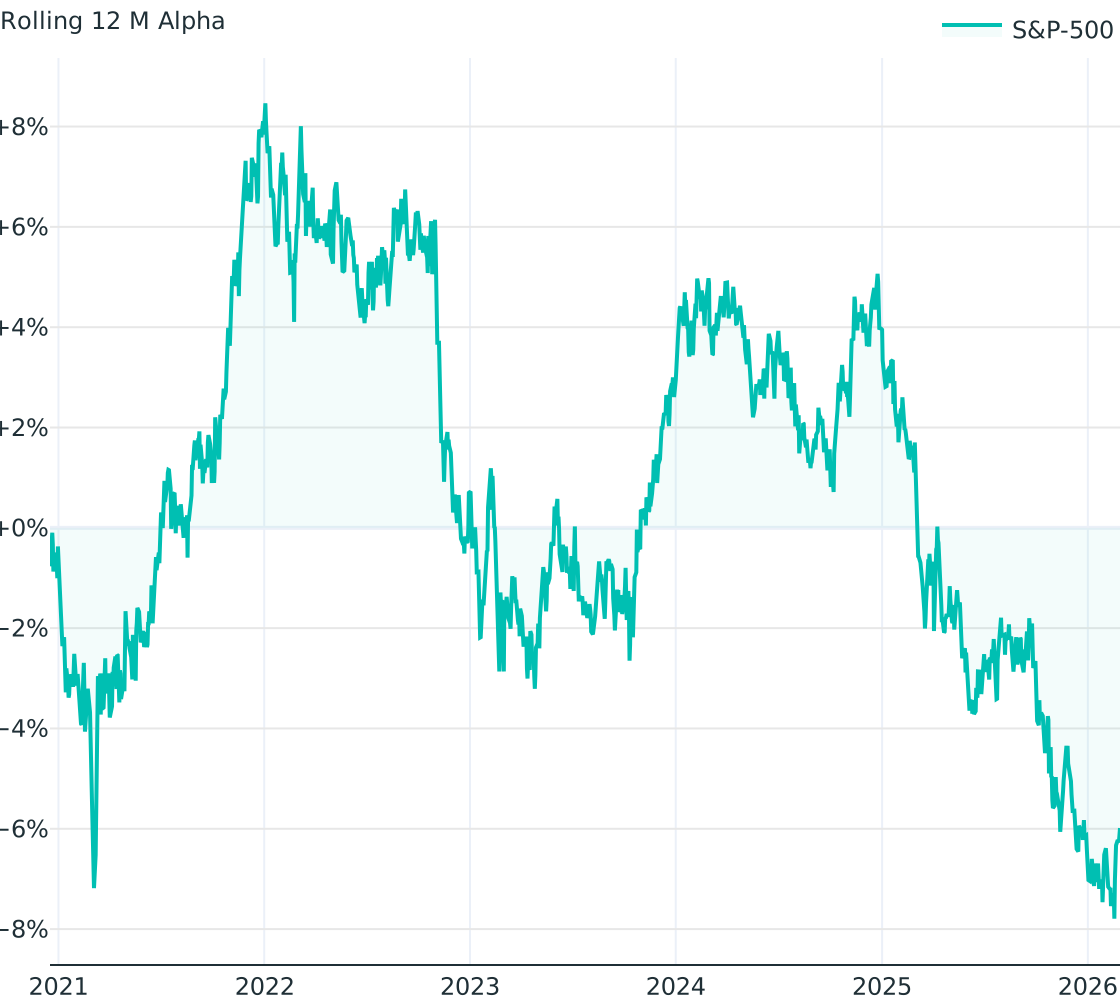
Rolling 12 M alpha: S&P-500 vs. ACWI
Rolling alpha is particularly useful for assessing the consistency of strategy performance. A strategy that shows consistently positive rolling alpha across different market regimes is demonstrating robustness. One that shows high alpha in certain conditions and negative alpha in others may be capturing a specific regime—momentum works well in trending markets, for example, and tends to struggle in sharp reversals.
Rolling alpha is available in the pfolio app. The benchmark is configurable in pfolio.
Limitations
Alpha depends heavily on the benchmark chosen. A multi-asset portfolio compared against a pure equity index will almost always show positive alpha in bear markets simply because it holds non-equity assets that did not fall as far. The same portfolio compared against an appropriate multi-asset benchmark might show very different alpha. Benchmark selection is a significant driver of the result and should be explicitly stated and justified.
Alpha is also backward-looking. Positive historical alpha reflects what the strategy delivered in the past; it does not guarantee future alpha. The conditions that generated past outperformance may not persist. Momentum strategies, for instance, can produce prolonged negative alpha during periods of sharp mean reversion.
Finally, short measurement periods produce unreliable alpha estimates. A year or two of positive alpha could reflect skill, a favourable market regime, or statistical noise. Meaningful alpha evaluation requires a full market cycle—typically five to ten years—encompassing both bull and bear conditions.
Alpha in pfolio
In pfolio, alpha is calculated from the return series derived from the price data. Whether those returns are computed from the close price or the adjusted close price can be configured via advanced settings—a distinction that matters for dividend-paying assets. The benchmark is configurable in pfolio and directly determines the alpha result.
Alpha and rolling alpha are available in the pfolio app. For a full description of how pfolio calculates this and all other metrics, see the metrics we use.
Related metrics
Disclaimer

Get started now


