



Cumulative return: how to measure total portfolio growth over time
Cumulative return measures the total percentage change in the value of an investment over a given period. It answers the most fundamental question any investor can ask: how much did this investment actually grow from start to finish?
What cumulative return measures
Cumulative return is the foundational output of any investment: it shows what a pound invested at the start became by the end of the measurement period, expressed as a percentage gain or loss. It is the unadjusted total return—the product of compounding all periodic returns over the measurement window. Fama, Fisher, Jensen, and Roll (1969) in The Adjustment of Stock Prices to New Information, International Economic Review, used cumulative abnormal returns as the primary measure of market efficiency—one of the earliest formalised applications of cumulative return in empirical finance.
Cumulative return captures the total gain or loss on an investment from an initial price to a final price, expressed as a percentage of the starting value. Unlike metrics that summarise return per unit of time, cumulative return is purely a statement of what happened over the full period observed—nothing more, nothing less.
The metric takes a price series as its input and produces a single number: the proportional change from the first price to the last. A cumulative return of 0.80 means the investment grew by 80% over the period. A cumulative return of −0.25 means it fell by 25%.
Higher cumulative return is generally preferable, all else being equal. But the metric carries no information about how long the period was, how smooth the path was, or how much risk was taken along the way. Two portfolios can show identical cumulative returns—one achieving it over three years, another over ten—and the cumulative return figure alone would not distinguish them. That is the starting point for understanding both its value and its limitations.
The formula
CR = Pn / P0 − 1
Where:
- CR = cumulative return
- Pn = price at the end of the period
- P0 = price at the start of the period
The formula divides the final price by the initial price and subtracts one to express the result as a return rather than a ratio. A final price of 180 against a starting price of 100 gives a cumulative return of 0.80, or 80%.
How to interpret cumulative return
Cumulative return is straightforward to read: a positive value is a gain, a negative value is a loss. The magnitude tells you how large that gain or loss was relative to the starting value.
As a concrete example: an investment that begins at USD 10,000 and grows to USD 14,500 over a five-year period has a cumulative return of 45%. The same USD 10,000 investment reaching USD 14,500 in 18 months also shows a 45% cumulative return. The number is identical—but the second outcome is clearly superior on a time-adjusted basis. This is where cumulative return requires careful handling.
A common misinterpretation is to compare cumulative returns across portfolios or assets without accounting for the measurement period. A 120% cumulative return over 20 years is a substantially weaker outcome than a 120% return over five years, but the headline figure suggests otherwise. Whenever cumulative return is used for comparison, the period must be stated explicitly and held constant across all comparisons.
Cumulative return is most useful as a straightforward statement of total outcome for a defined period—useful for reporting, client communication, and understanding the absolute size of a gain or loss.
Return time series
The return time series extends the scalar cumulative return across every date in the price history. At each point, it computes the total return from the first observation to that date—formally, CR(t) = P(t) / P(0) − 1. The starting value is always zero; the series grows or declines from there as the price moves relative to its inception level.
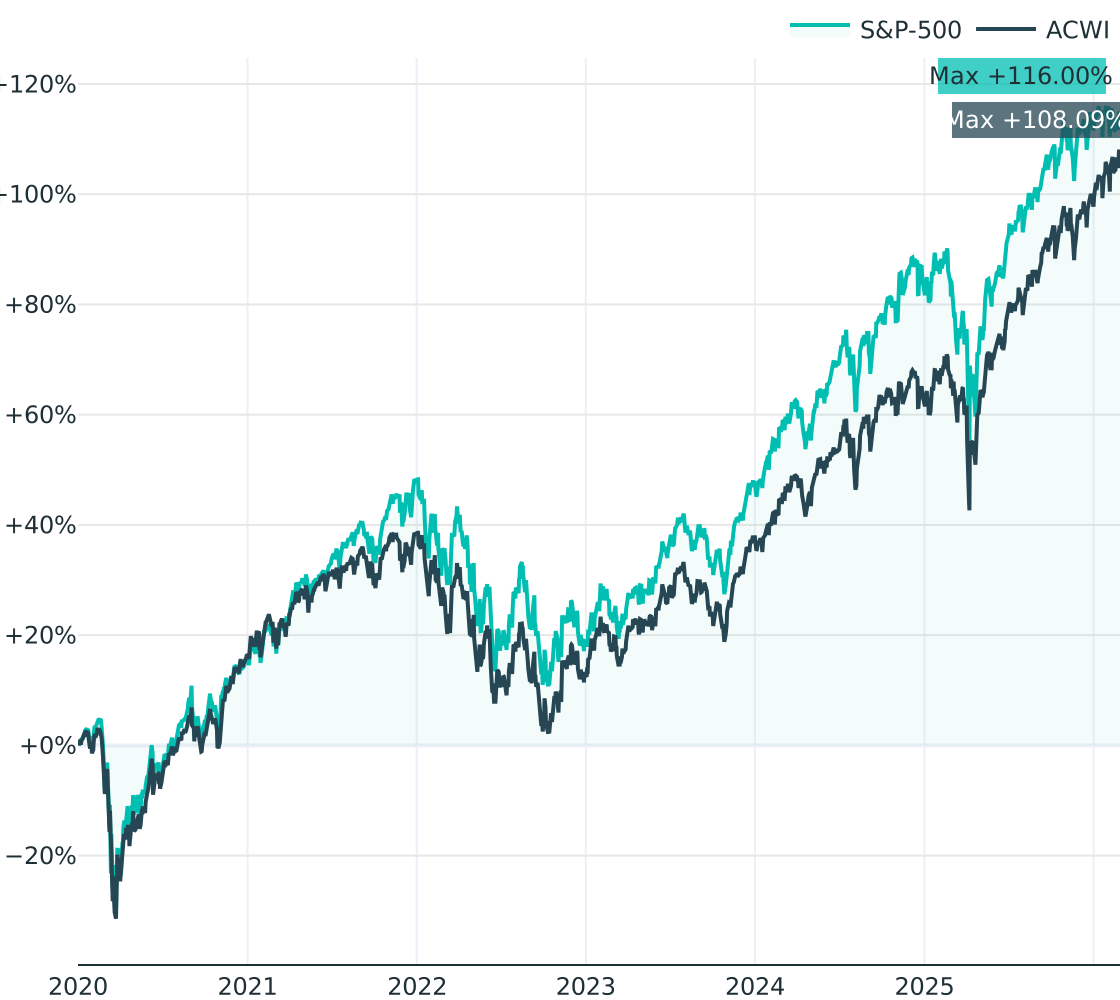
Returns over time: S&P-500 vs. ACWI
This view makes the full trajectory of an investment visible. An investment that ultimately delivered a 60% cumulative return may have spent extended periods in negative territory before recovering—a reality the scalar figure conceals. The return time series shows the path taken: periods of strong growth, flat intervals, and drawdowns that subsequently recovered. Comparing two assets or portfolios using their return time series over a shared history provides an immediate visual account of how their compounding paths have diverged.
The return time series is available in pfolio Insights and the pfolio app alongside the scalar cumulative return figure.
Limitations
The most significant limitation of cumulative return is that it contains no time dimension. A 100% cumulative return achieved over two years and the same return achieved over 15 years appear identical. For any comparison across periods of different lengths, CAGR (compound annual growth rate) is the appropriate metric—it expresses cumulative return on an annualised basis, making cross-period comparisons valid.
Cumulative return also says nothing about the path taken. An investment that doubled in value by going straight up and one that halved before recovering to double both show the same cumulative return. The experience of holding them—and the behavioural challenge of maintaining the position through a severe drawdown—was entirely different. Metrics such as maximum drawdown and volatility are needed to understand the journey.
Finally, cumulative return is sensitive to the start and end dates chosen. An asset that performed strongly except for a sharp decline at the end of the measurement period will show a much lower cumulative return than one observed over a period that happened to end at a peak. This sensitivity to endpoint selection is a known limitation; it should inform how results are communicated and compared.
Cumulative return in pfolio
In pfolio, cumulative return is calculated on time series price data. By default this uses the close price; switching to adjusted close—which accounts for dividends and splits—can be configured via advanced settings. The choice of price series affects the result, particularly for dividend-paying assets over long periods. See time series data and metric types for a full explanation.
Cumulative return is displayed alongside the return time series in pfolio Insights, as well as the pfolio app. For a full description of how pfolio calculates this and all other metrics, see the metrics we use.
Related metrics
Disclaimer

Get started now


