



Drawdown explained: measuring and understanding portfolio losses
Drawdown measures how far an investment has fallen from its most recent peak. It is the real-time risk gauge that tells you, at any given moment, how deep in the hole a portfolio currently sits relative to its highest value to date.
What drawdown measures
Drawdown is the standard measure of interim loss from a prior peak, and is used in both performance reporting and risk management. Its relevance to investor behaviour was highlighted by Grossman and Shiller (1981) in The Determinants of the Variability of Stock Market Prices, American Economic Review, who noted that observed price volatility exceeds what can be explained by rational dividend forecasts—with the implication that investor responses to interim losses (drawdowns) are a structural feature of market dynamics, not a marginal concern.
Drawdown is a point-in-time metric. It takes the current price and the highest price recorded up to that point, and expresses the gap between them as a percentage of the peak. If a portfolio reached a high of USD 120,000 and has since declined to USD 102,000, the current drawdown is −15%.
The metric returns a negative decimal (or zero). A drawdown of zero means the portfolio is currently at an all-time high. Any negative value means it is below its peak. The further below zero, the deeper the current decline.
Because drawdown is a 'higher is better' metric in pfolio—where 'higher' means closer to zero—a drawdown of −5% is preferable to a drawdown of −25%. In both cases the portfolio has declined from peak, but the shallower decline represents a better current state.
Drawdown is distinct from maximum drawdown: drawdown describes the current decline, while maximum drawdown describes the worst decline ever recorded over the full measurement period. Understanding both is important for managing a portfolio through difficult market conditions.
The formula
DD = Plast / Pmax − 1
Where:
- DD = current drawdown
- Plast = most recent price
- Pmax = highest price recorded up to the current date
The result is zero when the current price equals the peak price, and becomes increasingly negative as the gap between current price and peak widens. A portfolio at half its peak value has a drawdown of −0.50, or −50%.
How to interpret drawdown
Drawdown has a direct, practical interpretation: it tells you how much recovery is required to return to the previous high. A 20% drawdown requires a 25% gain to recover; a 50% drawdown requires a 100% gain. The asymmetry of loss and recovery is one of the most important principles in risk management—losses are harder to recover from than they appear.
A drawdown of zero is the ideal state. Any non-zero drawdown represents an unrealised loss from the investor's most recent high-water mark. In practice, portfolios rarely stay at zero drawdown for extended periods—some level of decline from peak is normal and expected.
Monitoring drawdown as a current indicator helps investors assess whether a portfolio is in recovery mode, approaching a prior peak, or deepening into a more significant decline. When drawdown is read alongside the drawdown time series chart, the pattern of how long past drawdown periods have lasted and how deep they have gone provides valuable context for current conditions.
Drawdown time series
The drawdown time series extends the point-in-time drawdown metric across the full price history. At every date, it computes the ratio of the current price to the highest price recorded up to that point, less one—formally, DD(t) = P(t) / max(P(s), s ≤ t) − 1. The result is a continuous record of how far below its running maximum the portfolio has been at each date in its history.
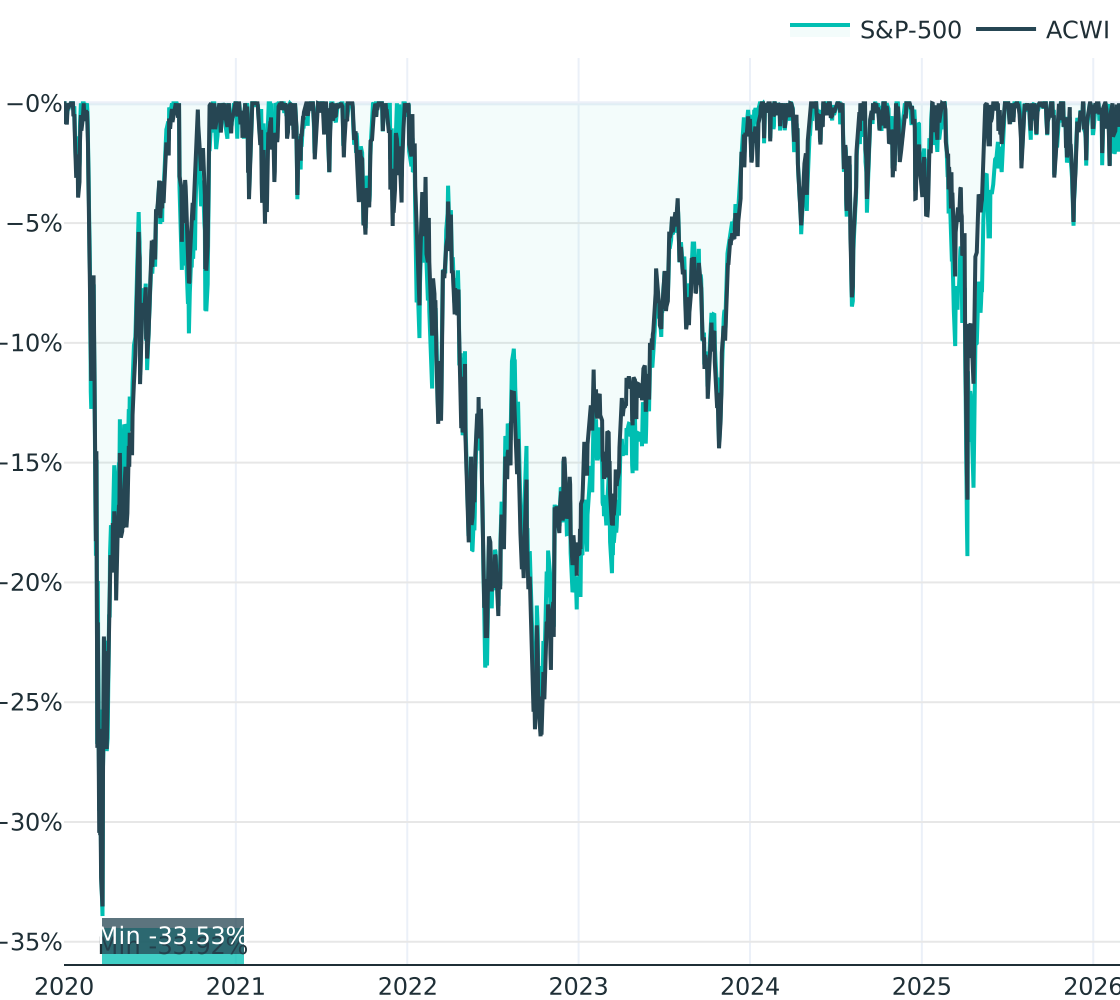
Drawdown over time: S&P-500 vs. ACWI
The series is always non-positive. A value of zero means the portfolio is at an all-time high. Any negative value marks the depth of the drawdown from the preceding peak. The chart makes drawdown periods directly visible: their depth, their onset, and their recovery. A series showing frequent shallow declines followed by rapid recoveries represents a very different investor experience from one showing infrequent but prolonged and severe drawdown periods—even if both produce similar maximum drawdown figures.
The drawdown time series is available in pfolio Insights and the pfolio app. It is particularly useful when evaluating how a portfolio behaved during specific historical episodes—the 2008 financial crisis, the 2020 pandemic drawdown, or the 2022 rate-driven decline.
Limitations
Drawdown is a point-in-time measure. It reflects only the current decline from the highest price to date, not the worst decline the portfolio has ever experienced. An investor looking at a drawdown of −5% today would not know from this figure alone that the portfolio previously experienced a −35% drawdown—a very different risk profile. For worst-case historical context, maximum drawdown is the relevant metric.
Drawdown also depends entirely on the starting point of the price series. A portfolio that begins measurement after a major decline may show a small or zero current drawdown while still being well below the levels that earlier investors experienced. The metric describes where the portfolio stands relative to its own history within the measurement window, not relative to any external reference point.
Finally, drawdown provides no information about the time required to recover. Two portfolios with identical current drawdowns may have very different trajectories: one recovering steadily, one continuing to decline. Drawdown tells you where you are, not where you are going.
Drawdown in pfolio
In pfolio, drawdown is calculated on time series price data. By default this uses the close price; switching to adjusted close—which accounts for dividends and splits—can be configured via advanced settings. The choice of price series affects the result, particularly for dividend-paying assets over long periods. See time series data and metric types for a full explanation.
Current drawdown and the drawdown time series are both available in pfolio Insights, as well the pfolio app. For a full description of how pfolio calculates this and all other metrics, see the metrics we use.
Related metrics
Disclaimer

Get started now


