


Asset allocation goals
Contents
Each rebalancing period a portfolio holds a chosen subset of its universe, not the whole of it. The Goals section makes that choice: together, a portfolio's goals determine the set of assets it holds for the period. Each goal ranks the universe by one or more metrics and selects its top-ranked assets; the selections of all goals combined are the holdings the optimiser then weights. The Performance and Hedge portfolios each have their own Goals section, and each can hold up to five goals with up to five metrics per goal.
Two settings sit above the individual goals and apply to all of them:
- Replace Duplicate Assets: a portfolio can use several goals, each selecting a different set of assets—one for high return, another for low volatility, say. If the same asset is selected by more than one goal, Replace Duplicate Assets, when on, takes the next-ranked asset instead, so the slot is not wasted.
- Ranking Inertia: keeps the current holdings from rotating out too readily, so the portfolio does not trade on every small change in the rankings—see Controlling turnover and adaptation speed.
Each goal has two settings of its own, alongside its metrics:
- Assets in Goal: the number of assets the goal selects each rebalancing period.
- Asset Selection: when on, restricts the goal to part of the universe, filtered by Asset Type and Asset Class. The goal then picks only from the assets that pass the filter.
A goal ranks assets by one or more metrics—for example, Sharpe ratio and mean return. The metrics themselves are defined in the metrics we use. For some metrics a lower value ranks better (volatility, down volatility, and kurtosis; for the Hedge Portfolio also beta and correlation); for all others, higher ranks better.
Each metric carries two settings:
- Weight: how much the metric counts towards the goal's combined ranking when more than one metric is used.
- Lookback: the span of price history the metric is calculated over. Each metric has its own lookback, so one goal can rank on, say, one-year momentum and three-month volatility at once. This is distinct from the optimiser's lookback—see Lookback windows.
Take a goal set up as in the screenshot below—it selects four ETFs by ranking on two weighted metrics, Sharpe ratio and mean return.
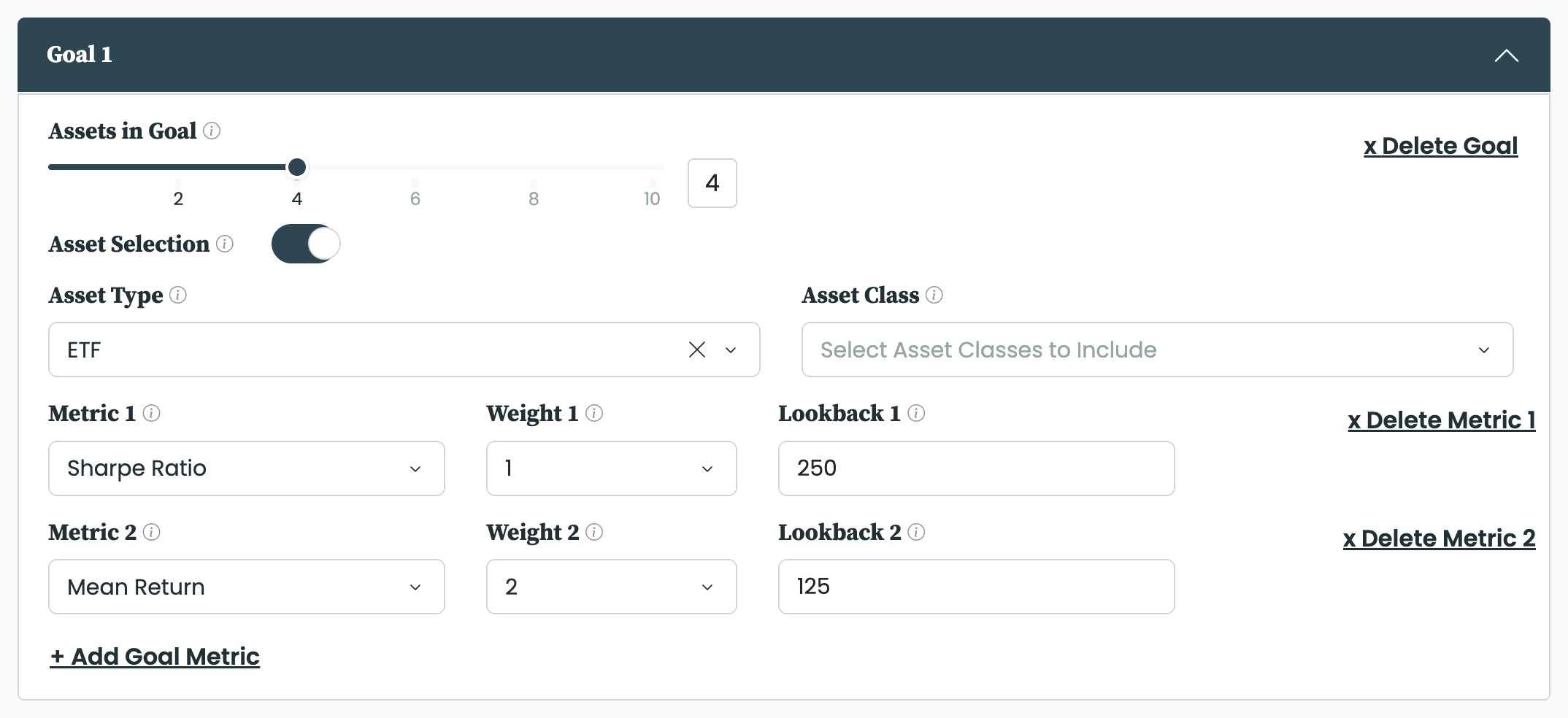
An example goal—four ETFs selected on Sharpe ratio (weight 1, lookback 250) and mean return (weight 2, lookback 125)
Each rebalancing period, the goal then selects assets in four steps:
- The Asset Selection filter narrows the universe to its ETFs; every other asset type is out of reach for this goal.
- The ETFs are ranked by Sharpe ratio over the last 250 weekdays—roughly one year. The highest Sharpe ratio takes rank 1.
- The ETFs are ranked a second time, separately, by mean return over the last 125 weekdays—roughly six months.
- The two rankings are combined into one score per ETF: the Sharpe ratio rank times 1, plus the mean return rank times 2. The lower the score, the better. The four ETFs with the best scores become the goal's selection for the period.
The weights shape the outcome: with weight 2, recent mean return counts twice as much as Sharpe ratio. An ETF ranked 3rd on Sharpe ratio but 1st on mean return scores 3 × 1 + 1 × 2 = 5, beating an ETF ranked 1st on Sharpe ratio but 4th on mean return, which scores 1 × 1 + 4 × 2 = 9. Only assets that rank well on the more heavily weighted metric can place near the top.
The Performance and Hedge portfolios each have their own goals, configured independently. Two metrics—beta and correlation—are available only in the Hedge Portfolio's goals. Correlation is measured against the Performance Portfolio's returns, so a hedge goal that ranks on it selects assets with a low or negative correlation to the Performance Portfolio—the mechanic behind the hedge, explained in Performance and Hedge portfolios.


