


Portfolio Setup advanced settings
Contents
The Advanced section in Portfolio Setup fine-tunes how a portfolio is built and how its metrics are calculated. Every setting has a sensible default, so most portfolios never need it opened; reach for it only when you want finer control.
| Setting | Default |
|---|---|
| Leverage | 1.0x |
| Start Date | end of the calendar year roughly ten years back |
| Price | Adj Close |
| Direction | Long |
| Risk-free Rate | 0% |
| Confidence Level | 95% |
| Transaction Cost | 0 bps, In Returns off |
| Currency Settings | Ignore Interest on, Default Funding on |
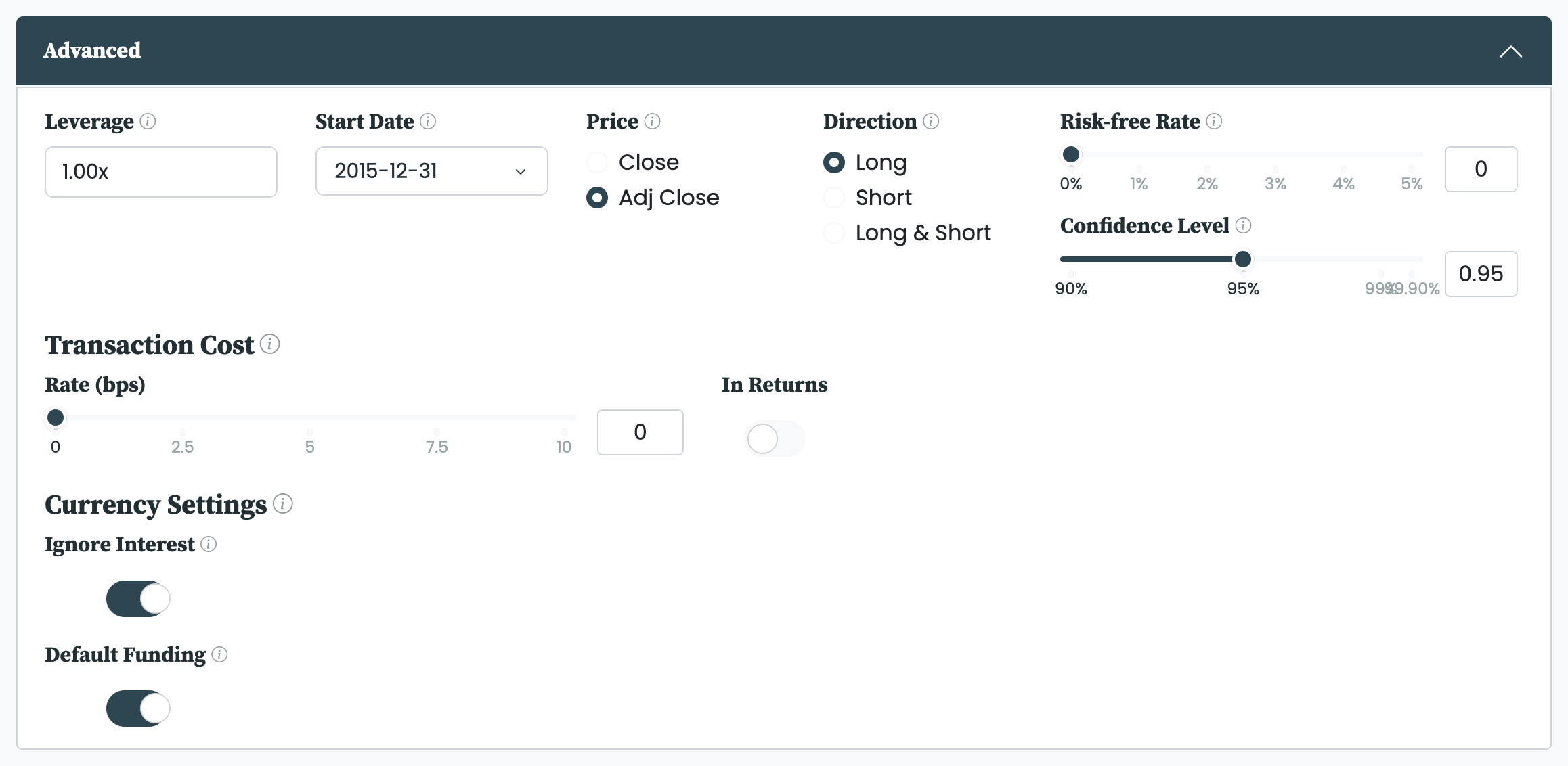
The Advanced section in Portfolio Setup
Leverage
Leverage scales exposure, between 0.1x and 5.0x. At 1.0x, 100% of net asset value is allocated; at 2.0x, both return and risk double. Borrowing costs above 1.0x and short-borrow fees are not modelled.
Start date sets when the backtest begins. The portfolio starts on the later of two dates: the start date you choose, and the first date on which at least N assets have a full lookback window of price history—where N is the number of assets the portfolio holds, summed across its goals—snapped to the first rebalancing date on or after that point. Periods before that are skipped, so the portfolio is never built from fewer assets than it needs. The default is the end of the calendar year roughly ten years back, and the latest start you can choose is one year before today.
Price chooses the series used for the calculation. Close tracks price movements alone; Adj Close adds cash distributions such as dividends and interest, and their reinvestment.
Direction sets whether positions are Long, Short, or Long & Short. A short position returns the inverse of the equivalent long position.
The risk-free rate is the annualised return achievable with zero risk, typically proxied by the yield on short-term US Treasuries. It feeds the Sharpe ratio, Sortino ratio, and alpha—see the metrics we use. When a goal ranks on one of those metrics, changing the rate can change which assets are selected, not just the reported figures.
The confidence level sets how far into the loss tail value at risk and expected shortfall look: at 95%, value at risk is the level the worst 5% of outcomes fall below, and expected shortfall is the average loss within that worst 5%—see the metrics we use. When a goal ranks on either metric, changing the confidence level can change which assets are selected, not just the reported figures.
A per-trade cost applied to rebalancing turnover. See Transaction costs.
How assets not held in the portfolio's currency are funded and converted, and how interest on cash is treated. See Currency and FX handling.


