


Portfolio optimisation
Contents
Four of the six are Markowitz mean-variance methods that share the same machinery; the other two, Equal Weight and Hierarchical Risk Parity, are not.
The six methods
| Method | What it does | Needs |
|---|---|---|
| Risk Level | Markowitz mean-variance: maximise expected return for a selected level of risk | expected returns + covariance |
| Efficient Risk | Maximise expected return subject to a target volatility | expected returns + covariance |
| Efficient Return | Minimise volatility subject to a target return | expected returns + covariance |
| Max Quadratic Utility | Maximise expected return minus a risk-aversion penalty on variance | expected returns + covariance |
| Equal Weight | Allocate equally to every selected asset | nothing |
| Hierarchical Risk Parity | Cluster the covariance matrix and allocate risk down the hierarchy | covariance only |
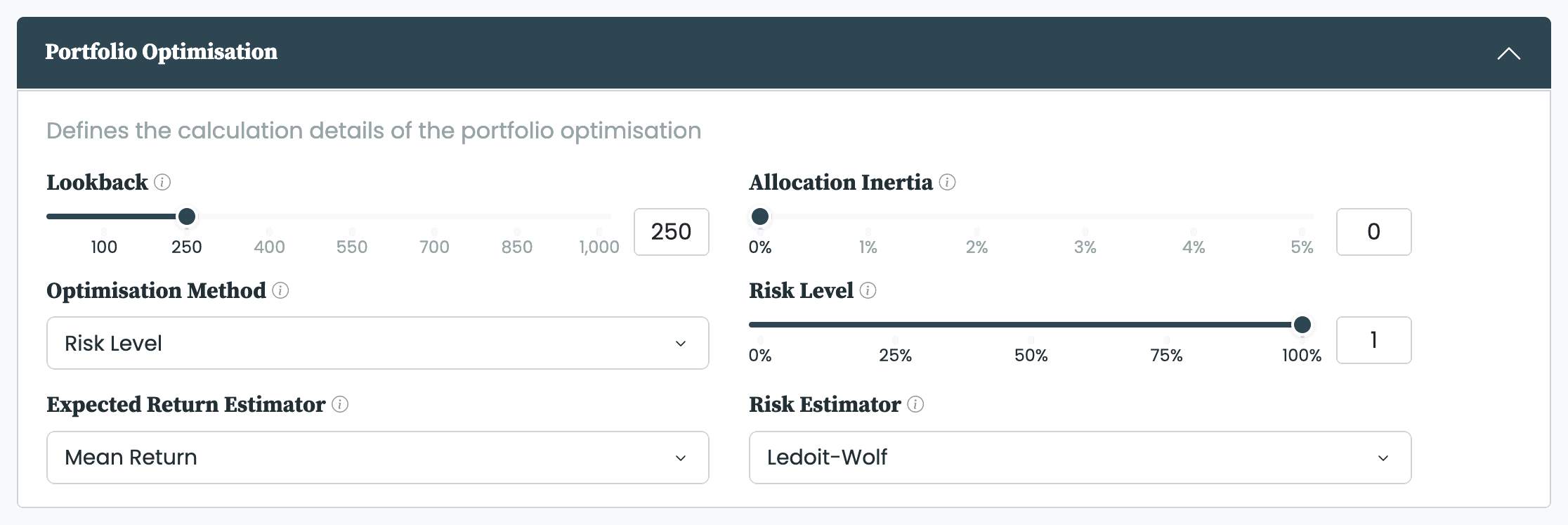
The Portfolio Optimisation section with Risk Level selected
Markowitz mean-variance methods
Risk Level, Efficient Risk, Efficient Return, and Max Quadratic Utility are all Markowitz mean-variance methods. They share the same inputs—an expected-return vector and a covariance matrix—and the same lookback and constraints. They differ only in what they optimise:
- Risk Level maximises expected return for a chosen level of risk. The general-purpose default.
- Efficient Risk fixes a target volatility and maximises expected return at it. Use when a specific volatility is the goal.
- Efficient Return fixes a target return and minimises volatility for it. An unreachable target makes the optimiser fail.
- Max Quadratic Utility maximises expected return minus a risk-aversion penalty on variance. A low risk-aversion coefficient is aggressive; a high one is defensive.
All four concentrate on whichever assets look best, so when the expected-return estimate is noisy the result is brittle. The estimator matters as much as the method. See Markowitz methods for the per-method detail.
Equal Weight allocates the same weight to every selected asset. It needs no estimates—not expected returns, not a covariance matrix. Best as a transparent baseline that any other method should beat. Avoid for universes with very different per-asset volatilities; equal weights do not produce equal risk.
Hierarchical Risk Parity (HRP) clusters assets by correlation, then allocates risk down the hierarchy. It needs a covariance matrix but no expected returns. Best when the universe has clear cluster structure (equities plus bonds plus commodities) and the allocation should respect it. Avoid when the clustering signal is weak. See Hierarchical risk parity for the detail.
Inputs shared across methods
| Input | Used by | What it does |
|---|---|---|
| Expected-return estimator | the four Markowitz methods | Often matters more than the choice of method itself. Catalogue in the Markowitz methods article. |
| Risk (covariance) estimator | every method except Equal Weight | Shrinkage estimators (Ledoit-Wolf) produce more stable allocations than sample covariance when the lookback is short relative to N. |
| Lookback window | every method except Equal Weight | Short window: reactive but noisy. Long window: stable but slow to adapt. See Lookback windows. |
Equal Weight uses none of these inputs. That is the point.
With N. Equal Weight is fully determined by N. The Markowitz methods can concentrate when N is small. HRP stays diversified through its clustering step. See Selecting assets for a portfolio.
With constraints. The Markowitz methods apply the per-asset bounds and the cash range directly. The per-asset bounds do not apply to Equal Weight and HRP, and when Cash is on, those methods hold it at the minimum of the Cash Allocation range. See Asset allocation constraints.
With the Hedge Portfolio. The Performance and Hedge portfolios each carry their own optimisation method. A common pattern is a Markowitz method on the Performance Portfolio and HRP on the Hedge Portfolio, but every combination is valid. See Performance and Hedge portfolios.
The choice comes down to two questions. First, do you trust your expected-return estimates? If yes, use a Markowitz method, and pick by goal: a chosen level of risk → Risk Level, a target volatility → Efficient Risk, a target return → Efficient Return, a risk-aversion trade-off → Max Quadratic Utility. If no, use an estimate-free method, and ask the second question: does the universe have clear cluster structure? With clear clusters, Hierarchical Risk Parity; without, Equal Weight. The per-method articles cover when each one shines and when it breaks down in more detail.


